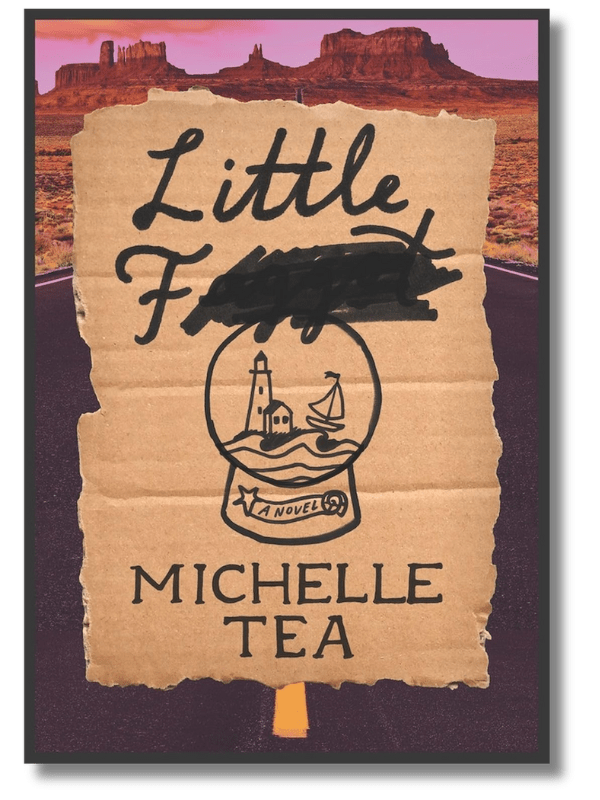
Little F
by Michelle Tea
Genre: Literary Fiction / LGBTQ
ISBN: 9781558613560
Print Length: 232 pages
Publisher: Feminist Press
Reviewed by Andrea Marks-Joseph
This hope-fueled runaway’s roadtrip is a sheltered queer teen’s awakening to the real world.
A love letter to gay delusion, in the best way, author Michelle Tea’s Little F charts the consequences of a suburban teenage boy’s deepest wishes, daydreamed in desperate need to believe that there’s a gay utopia out there waiting for him with arms wide open.
Set in 2010, we follow thirteen year-old Spencer who runs away from home with the support (via magic spells and well-placed curses) of his “best/only friend,” a teenage witch named Joy. Readers will love Spencer, “a gay teen born in a suburban hellhole,” from the moment they meet him. While trying to count his blessings despite a crowd gathering to watch him being beaten up by a bully, Spencer remarks that at least he’s not being killed by a hippo: “Imagine the stink of its breath out of that enormous mouth! You would die in that cloud of breath. Your last thought would be Oh God, ewwwww as it took your head into its jaw and snapped your neck.”
I still can’t stop thinking about Spencer trying to untangle the logic of being frequently assaulted for being gay, despite never having even had a crush on a boy, let alone having kissed one. This endearing thirteen year-old, trying to stay positive mid-assault, lamenting that he’s only experienced the bad parts of being gay, none of the good.
Spencer’s world turns upside down again when he gets home from the hospital post-assault. In a scene so exquisitely devastating that you’ll have to read it to learn the details, Spencer can’t see a way forward if he stays in this town.
He calls Joy, surprising even himself when he blurts out, in that raw honest way that only teenage best-friendship allows for, that he’s going to kill himself. She tells him that a “sort of media explosion” happened while he was in hospital, where by some gay coincidence, a string of deaths happened across the country, all of them gay kids who were also bullied at school, raising a national conversation about teenage suicide and queer kids being bullied.
In response to his very dark confession, Joy tells Spencer that he can’t consider suicide right now, “because you’ll just seem like you’re trying to be trendy.” Spencer immediately pivots to deciding that he will run away. “Running was the second most popular choice made by teens in despair, according to the internet,” he tells us. “After suicide,” he adds for context.
Spencer “searched gay cities and Provincetown came up a whole bunch,” so he’s decided that’s where he will run away to; confidently, recklessly up for the risks it will entail, his entire plan being “to see what happened without caring too much about it.” His internet searches allowed him to dream of this good, gay place where every day feels like a parade of queer acceptance. These daydreams conjured up a gay uncle, entirely imaginary but more real to Spencer than most of his everyday life.
Spencer’s increasingly delusional commitment to getting to Provincetown to find this gay uncle reveals his fierce hope in a great, gay future, no matter the tumultuous road to get there: “It was a magical place, and much like all fairy tales, to get there I would have to find my way through hostile territory. Texas alone is like its own angry nation, one that takes multiple days to get through.”
When he accidentally becomes an accomplice to a robbery and assault, Spencer ends up entranced by a boy named Velvet and the freedom he finds even in the difficulties of being homeless with him. Velvet allows Spencer to join him on his way to New Orleans, teaching him survival tactics on their journey.
Spencer falls in love with the eclectic charm of New Orleans—where he can be messy and as loud about his queerness in ways he never imagined possible before. He finds comfort—and the joy of queer nicknames—with a group of teens at a shelter, who make him feel “like I was suddenly part of the best club, both incredibly elite yet also open to every single person who walked through the door. I felt suddenly, extravagantly happy.”
Little F is filled with rich descriptions, like this one from Spencer’s first drag show: “Blush cut up the sides of their faces like spray paint; their faces looked like murals of faces. Their mouths were luscious and muscular, working around the songs like they were eating them, and their hair looked like bird’s nests or war helmets, like Marie Antoinette or Dolly Parton.” The story will have you wanting to protect Spencer at all costs and feeling thankful for everyone who does so; your heart filling up with so much love for him, for Velvet, and for every queer teen and every runaway who did what they felt they had to—lied and stole and changed their name, however clumsily. You’ll understand the homeless people in your lives a little more, and you’ll fall in love with New Orleans the way Spencer did. “Maybe the old me would have blanched at the thought of sleeping in a cemetery, but dead people don’t hurt you like living people do, and I felt in my heart that if I were forced to sleep on the hard stones of the New Orleans cemeteries, New Orleans would protect me.”
In Little F, grown men proposition vulnerable boys for sexual favors, and the boys “cruise for child molesters” to steal from when they do. Spencer wrestles with the sudden ethical dilemmas of being thrust into homelessness and forced to make money-or-morality, civility-or-survival choices in the moment. This story uses the f-slur frequently and includes the harsh realities of a world where Spencer must rely on strangers for survival, but it doesn’t feel written for drama or shock value, and it never puts him in harms way for fun—even when characters discuss the ways their parents disappointed or endangered them or when extremely underage kids are handed liquor while they’re on the run.
Michelle Tea wrote Spencer an adventure that felt very much in conversation with all the potential threats and risks of a sheltered teenager going out on his own for the first time, while still managing to protect him in a way that feels spontaneous and realistic. I say this to assure readers who are interested in this sweet, special runaway boy but don’t want to read a story filled with the harsh dark moments that the world could bring down on him. Little F loves Spencer as much as we do and doesn’t force him into trauma. Instead, Spencer learns through love and the generosity of strangers and sees his near-misses through a rose-tinted haze of queer found family.
I’d highly recommend Little F for readers of queer coming-of-age stories and anyone looking for a hopeful gay story that starts in a small town and discovers the world. If you’ve ever felt moved by a story about a young boy who fought his way out of the town that had a small life planned for him or someone who spent their entire childhood feeling like they wouldn’t get to have a big, beautiful life unless they ran away, you’ll adore Spencer. If you’ve ever cared for a fictional teen character as if they were your own, regardless of genre, but especially if they’re queer, Little F is the book for you.
I will be thinking about Spencer for a long time and loving him for even longer. He burrowed his way into my heart and made a home there, in the same achingly sweet way he caught the eye of countless Little F characters by unintentionally wearing his heart on his sleeve. I went into this story expecting that it may break my heart or force me to face the horror of the world head-on. Instead, the only thing that weighs heavy on me as I write this is the fact that I can’t give Spencer and Velvet the biggest, strongest hug, and make sure I look them in the eyes while telling them, from some otherworldly place of wisdom that they might believe, how smart and brave they are, how much they deserved a world that was kinder to them from the beginning, and how miraculous it is that they found softness in each other through it all.
I felt an ache in my chest each time Spencer learns that being gay can be good, can be fun, can be something you want to show off and shout about and be welcomed for. And I felt a sharper ache when he learned that someone gay can look completely ordinary. I remain struck by the way Michelle Tea’s writing is true to the suburban teenage experience of Spencer not even knowing how much he doesn’t know about the real world. Even at the end, when he has seen so much of it, perhaps faced more reality than his parents ever will, there’s still so much he doesn’t know. “Here I was, pampered and deluded, working double time to play catchup, to harden myself to this country that Velvet always knew was trash.”
By the time this story ends, Spencer’s been truly loved by all kinds of people across the country, and he’s certain that this is only the beginning. I could burst into tears with gratitude for and pride in this boy who, with some distance and perspective from his runaway roadtrip, remains convinced that “Like, if I wasn’t so delusional, I might have never left Phoenix, never met Velvet. Not only would I have stayed so sad and lost but my parents would have, too.”
Thank you for reading Andrea Marks-Joseph’s book review of Little f by Michelle Tea! If you liked what you read, please spend some more time with us at the links below.
The post Book Review: Little F by Michelle Tea appeared first on Independent Book Review.