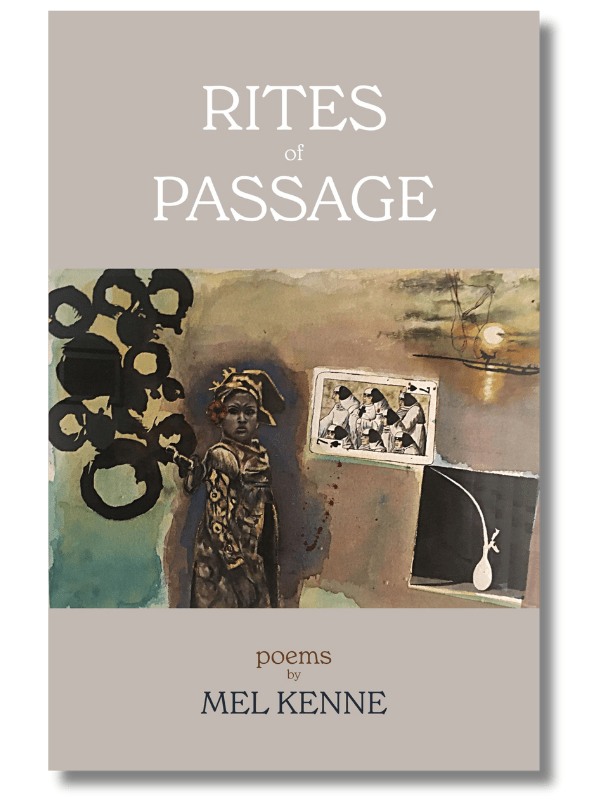
Rites of Passage
by Mel Kenne
Genre: Poetry
ISBN: 9798891328471
Print Length: 192 pages
Publisher: Atmosphere Press
Reviewed by Nikolas Mavreas
A fearless look into an unforgiving mirror—a collection of intensely personal poetry cooled by objective reflection
Mel Kenne has over forty years of published poetry behind him, and all his experience and weary wisdom is reflected in this moving new collection. A multivarious volume, Rites of Passage brings forth poems that are connected through retrospection and the serene if unsure acceptance of everything that comes with life.
Dealing with origins, a couple of poems grapple with the classic father and son dynamic. In “Sun and Shadow,” Kenne compares the two in parallel, leading to a convergence before they split again in the last lines. Elsewhere, the son sees in a dream that he cut off his father’s head, as we conclude with a truth that no father or son has ever been perfect.
Going back a couple more generations, Kenne juxtaposes the Nietzsche with the Yeats in himself, owing to his double German and Irish roots. Looking into the much deeper past, the poet reflects on ancient ruins, where tourists impose themselves upon the “stone blocks in their sunny playground.”
Becoming more grave, he considers “a place / where non may die / unsung, unmourned,” going on to will a “sanctum sanctorum, / let’s say, on a wall / made of smiling skulls,” the off-hand “let’s say” contrasting with the startlingly specific final image. Kenne, who lives on the Aegean coast of Turkey among, around, and right on top of traces of ancient civilization, may have taken inspiration for this image from the recent discovery in that region of an ancient mosaic featuring a reclining skeleton enjoying a cup of wine, with “the happy one” inscribed over his head.
Throughout these pages, the poems wrestle with what it is that matters in the end. The poet seems to be moving toward a place free of desires, which may be attainment of “some higher plain of being / or another small, earthly gain.” He prays to no one and expects nothing, which seems like either happiness or terror, depending on your point of view. Does he himself matter? He feels guilty and powerless watching the world go to hell while doing nothing for posterity, but he “can’t write for the ages,” he “can only write for the hour.” The value of his proclaimed reason for existing depends, once more, on your point of view, but he preempts the doubters and offers reassurance:
“What I live for now / is a cat, a cat who lives with, and for, me. / I live for her life and mine to remain / here another day. Don’t be sad, this isn’t. / Love never is.”
Presenting an overall apathetic attitude toward death, the book contains many moments which defy that apathy. Moments like those that are to be found in “August’s chirping amphitheater of desires,” or those slices of life provided by “the bright, cutting edge /of the first cold front, / with its razor-sharp division / of each moment.”
For Kenne, writing poetry is finding solace, something which is expressed indirectly but also explicitly in this work. And as much as poetry conveys and is a large part of his past, it also holds his future, which is “vested in a small stock of words.” So there is a conflict when in the end he declares “I am empty now of you – of poetry. Finally!” Perhaps Kenne teaches that we must be able to let go even of the things that are most central to our identity. Rites of Passage contains writing of great character and deep personal expression, and its words of goodbye can be felt as a minor act of bravery.
Thank you for reading Nikolas Mavreas’s book review of Rites of Passage by Mel Kenne! If you liked what you read, please spend some more time with us at the links below.
The post Book Review: Rites of Passage by Mel Kenne appeared first on Independent Book Review.