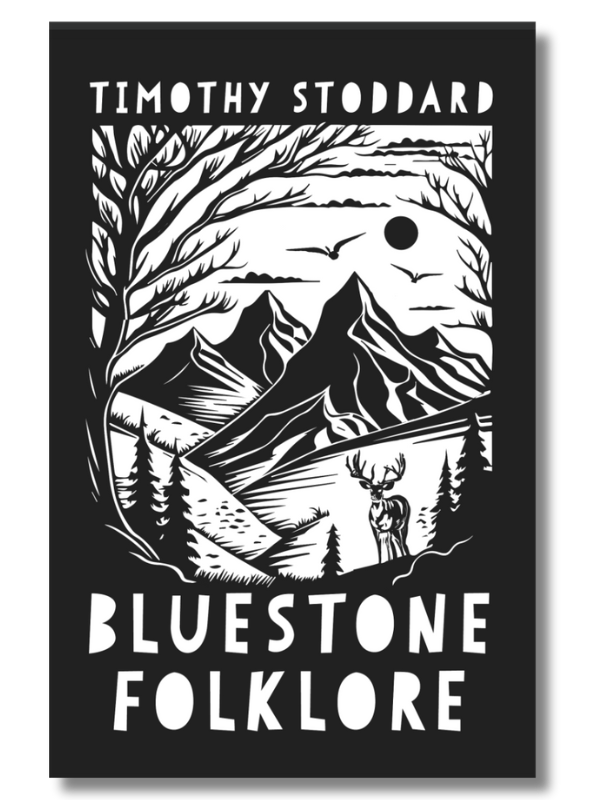
Bluestone Folklore
by Timothy Stoddard
Genre: Gothic Fiction / Sci-Fi & Fantasy
ISBN: 9798988435136
Print Length: 244 pages
Reviewed by Lauren Hayataka
A tender hymn to the fragile pulse between creation and decay
In Bluestone Folklore, Timothy Stoddard builds an Eden of his own making—a woodland alive with myth, violence, and theology.
Set against ecological collapse, the novel follows the creatures and caretakers of the Bluestone Woodland, a place bound by a sacred apple tree said to anchor all life. Around it circles the Old Man, a retired physician mourning his lost partner, Fay; the white-faced Yearling, a rare fawn born after many barren seasons; and the Man with the Crooked Finger, whose hatred of deer and human frailty drives him to horrific violence.
Bluestone Folklore is in the tradition of American eco-gothic: a landscape where faith, shame, and nature intertwine. When the Man with the Crooked Finger launches his “Thin the Herd” crusade, the forest becomes a battlefield between reverence and destruction. The Old Man—a reclusive and reluctant guardian—sees the violence creeping toward his acreage and the deer that depend on it. His paintings of the herd become acts of prayer; his grief, a form of devotion.
Author Timothy Stoddard thrives most as he turns his gaze to the minute and the mortal, his prose razor sharp in small, sensory truths: the sight of a cat walking across the hood of a car, pressing into the metal with fleshy paws; an apple’s red-gold skin catching the afternoon light; and the heartbreaking image of a sparrow lining its nest with the hair of his murdered human friend. These moments of intimacy—where the divine meets the visceral—anchor the story’s larger ideas about creation, loss, and the porous border between man and beast.
The deer are rendered with startling sensitivity. The Yearling’s curiosity about death—the “lazy rabbit” she nudges, the silence of her aging mother—captures a pure, instinctual wonder, never tipping into sentimentality. Stoddard understands that animals grieve through motion and memory, not words. These passages recall the precision of Jane Smiley’s animal writing: the delicate balance between observation and empathy. It’s a contrast that sharpens the novel’s tragedy: the Yearling, later the Doe, set against the Man with the Crooked Finger—a man who has lost the language of instinct, who speaks of God but no longer knows how to feel awe.
What gives the story its quiet pulse is the Old Man himself—a figure caught between science and faith, reason and awe. His grief is rendered not as stillness but as creation: through each painting, he rebuilds what the world around him destroys. The apple tree becomes his altar, the deer, especially the Yearling, his communion. Yet even he is not free from fear. Like the Man with the Crooked Finger, whose shame curdles into cruelty, the Old Man is haunted by the boundaries of his belief—by the fear of intervening, of failing, of becoming part of the violence he despises. Stoddard captures how easily faith can bend toward fanaticism, how reverence can coexist with guilt. In both men, fear becomes a mirror: one reflects compassion restrained, the other cruelty unleashed.
Bluestone Folklore is not an easy or comfortable read. Its biblical parallels to Genesis and the Fall can feel heavy-handed, and the violence—especially toward animals—is often difficult to bear. Even so, this weight gives shape to Stoddard’s larger vision: that humanity’s original sin is not disobedience, but forgetting its place in the natural order. The Man with the Crooked Finger’s cruelty, from crushing a fawn to death to turning faith into a weapon, presses so hard on its allegory that it risks flattening its humanity. Still, through this brutality, Stoddard searches for redemption: for the ways pain moves through generations, how shame reshapes belief, and how love, once destroyed, finds quieter afterlives in the natural world. Everything moves in cycles, and reason follows in their wake.
And within those cycles of pain, there is still movement—small, persistent, alive. Stoddard’s woodland breathes in rhythm with its creatures: a flutter of wings, the rustle of leaves, the faint pulse beneath the soil. Bluestone Folklore movingly reminds us that creation and destruction are not opposites but mirrors, and that awe, once lost, can still return in the instinct to endure.
Thank you for reading Lauren Hayataka’s book review of Bluestone Folklore by Timothy Stoddard! If you liked what you read, please spend some more time with us at the links below.
The post Bluestone Folklore by Timothy Stoddard appeared first on Independent Book Review.