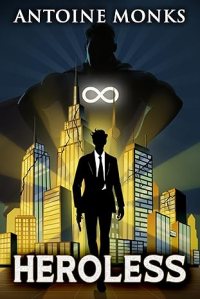
Synopsis:
It’s been fifteen years since the supervillains conquered the world, and Ledge Carp—better known as the maniacal Crime Clown—is restless. With his archenemy Fox Man long dead and no one left to challenge him, the world feels dull.
When an alien warlord named Siege returns to Earth with an armada prepared for invasion, Carp must join forces and defend their fragile world with the very villains who despise him.
Former superhero Elizabeth Morrison struggles to find peace. Haunted by doubts about her worth as a hero and the bloody final battle that ended it all, she’s pulled back into her past and into the mystery of what really happened the night the heroes fell.
As their paths draw towards each other, old powers stir, old enemies rise, and the line between hero and villain blurs as the world faces destruction.
HEROLESS is a story of broken champions, ruthless survivors… and the cost of a world with no heroes left.
Favorite Lines:
“They think in terms of comics and heroics or else they’d use their gifts for other things.”
“Heroes don’t know how to live quietly.”
My Opinion:
I received a copy of this book from the author in exchange for my honest opinion.
Heroless opens in a world where the story everyone expects has already ended. The heroes lost. The villains won. And the people left standing are not celebrating so much as drifting, stuck inside the long shadow of a victory that hollowed them out. The book begins with Wedge Carp, formerly the Crime Clown, and immediately sets the tone: this is a story about aftermath, boredom, regret, and the uncomfortable quiet that follows conquest. Carp is cruel, vain, tired, and strangely sad, and Monks allows him to be all of those things at once without softening the edges.
What makes Carp compelling is that he is neither repentant nor triumphant. He misses the game. He misses Fox Man not as an enemy, but as a purpose. The city he once reshaped into Clown Town has faded back into gray, mirroring his own internal stagnation. The world-building here is rich but lived-in. This isn’t a dystopia explained through exposition so much as one revealed through neglected details, decaying spectacle, and bitter humor. The New Order feels less like an efficient regime and more like a coalition of powerful people barely tolerating one another.
As the narrative expands beyond Carp, Heroless becomes even more interesting. Elizabeth’s chapters offer a sharp contrast, bringing readers into the quieter grief of a former hero who survived but was never celebrated in the same way. Her memories of patrolling, forming the first hero teams, and idolizing figures like Blue Saturn and Justice-Hand feel painfully sincere. Elizabeth’s story captures the loneliness of stepping back into civilian life with memories no one else shares and no language to explain them. Her longing is not just for heroism, but for belonging.
The villains, too, are given surprising dimension. Figures like Doctor Corman, Fire Ruby, Grey Skull, and others aren’t simply evil masterminds. They are egos in constant tension, bound together by convenience and fear rather than loyalty. The introduction of a mysterious new superhuman becomes less about threat and more about disruption. It forces everyone, heroes and villains alike, to confront what power actually means in a world already broken.
What stayed with me most after finishing Heroless was its refusal to romanticize either side. Heroes were flawed long before they fell. Villains are not fulfilled by their victory. The book is less interested in battles than it is in identity, legacy, and the question of what people become when the roles that once defined them no longer apply. It’s cynical without being empty, and thoughtful without being nostalgic.
Summary:
Overall, Heroless as a layered, emotionally grounded take on the superhero genre that focuses on what happens after the mask comes off, permanently. It works best when it explores disillusionment, memory, and power without offering easy redemption or clear moral anchors. Readers who enjoy darker speculative fiction, morally complex characters, and stories about identity after collapse will likely find this deeply engaging. This is a superhero story that isn’t really about heroics at all, but about survival, relevance, and what lingers when the world moves on. Happy reading!
Check out Heroless here!
Check out the book trailer here!