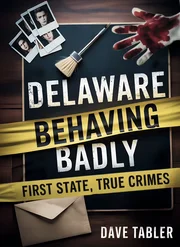
“Delaware may be small, but its criminal history contains multitudes,” writes Tabler at the outset of his narrative of the Diamond State’s seamy underbelly. “These stories span a spectrum—from blood-chilling murders that haunted generations to curious capers lost in dusty archives, from soul-crushing injustices that demanded reform to schemes so preposterous they strain credulity.” Tabler takes his readers through the gamut of the seediest misdeeds, from statewide scandals involving prominent politicians and other public figures to grotesque local murders, all drawn from state lore extending well over a century. He tells readers about Noah Benson, whose headless body was found in 1891 in the Chesapeake and Delaware Canal, sparking a sensational murder trial that filled the headlines of all the local papers (the head was never found). A more contemporary account outlines the sexual predation of pediatrician Dr. Earl Bradley, who in the 1990s abused dozens of children (a nurse claimed that he “made girls undress before routine exams, kissed and hugged them, and remarked about attractive mothers”). Tabler mentions that state Attorney General Beau Biden wanted Bradley’s offices “wiped off the face of the earth.” In most cases, Tabler offers larger lessons to be learned. For example, about bigamist clergyman Irvin Taylor, who had a deserted wife in Delaware while he was an upstanding married man in Iowa, Tabler writes, “The scandal exposed something more universal: the ease with which a man entrusted with moral and spiritual leadership could live a lie in plain sight.”
A less talented writer might have assumed that the salacious nature of this kind of history would do most of the heavy lifting as far as entertaining readers, but Tabler knows better. He turns the history he’s researched into good stories and often contextualizes it; regarding lawyer-turned-murderer Thomas Capano, he writes: “The once-powerful attorney who had manipulated the highest echelons of Delaware politics—and believed himself untouchable—died alone in a prison infirmary. It was a final, ignominious chapter in his fall from grace.” The author also delves deep into specifics, aided by both his vast research and his sharp ear for great quotes plucked from regional publications, as when Delaware’s newspaper Every Evening wryly commented on customers who persisted in drinking backwoods moonshine even after the state’s Liquor Commission issued beer-making licenses: “Tell the nation that instantaneous death would result from pulling the lobe of the left ear four times in rapid succession, and the undertakers would do a big business.” He’s equally adept at highlighting either absurd dark humor or savage tragedy, depending on the nature of the horror he’s describing, and his choices give the book a fine feeling of balance and depth. He tells the story of a constable named Brown found throttling Wilmington’s mayor in 1891 (“Yes, I grabbed him by the throat,” the constable evenly said, “but he grabbed me first”) with as much storyteller commitment as he does the many con artists who’ve targeted the most vulnerable throughout the state’s history. It’s all done with energy and detail; true crime fans and Delaware history buffs will be delighted.