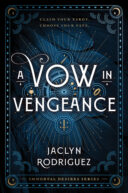
Jaclyn Rodriguez’s debut novel A Vow in Vengeance by Jaclyn Rodriguez emerges as a bold entry into the romantasy arena, weaving together tarot-based magic, political intrigue, and enemies-to-lovers tension within a cutthroat collegiate setting. While the novel demonstrates impressive world-building and character development, it occasionally stumbles under the weight of its own ambition, creating an engaging yet imperfect reading experience that will resonate with fans seeking morally complex protagonists and high-stakes romance.
A World Built on Blood and Cards
Rodriguez constructs an intricate magical system rooted in tarot symbolism, where druids channel power through twenty-two Major Arcana cards, each representing a distinct ability. From the Fool’s fearlessness to the World’s omnipotent mastery of all powers, the magic system feels both ancient and visceral. The Selection—an annual reaping where one hundred mortals are transformed into changelings to sustain immortal lineages—forms the cruel backbone of this society, a consequence of a blood curse that stripped immortals of their ability to bear children.
The Forge, a dark academia institution where changelings learn to harness their newfound abilities, becomes the primary setting for much of A Vow in Vengeance by Jaclyn Rodriguez. Rodriguez excels at capturing the claustrophobic tension of a school that serves simultaneously as sanctuary and prison. Students navigate hierarchies not just of power but of survival, where every friendship might be strategic and every alliance temporary. The volcano-shadowed campus, with its obsidian architecture and lava-lit corridors, pulses with atmospheric menace that mirrors the protagonist’s internal rage.
Rune Ryker: Fire-Forged and Uncompromising
Twenty-year-old Rune Ryker enters the narrative already hardened by loss. Having lost her brother to the elves at six, her father to the seraphs at thirteen, and her mother to the druids at fourteen, she orchestrates her own Selection with singular purpose: reunite her fractured family and exact vengeance on those who destroyed her life. Rodriguez refuses to soften Rune’s edges—she’s pragmatic, occasionally ruthless, and carries the skills of her former life as the Wraith of Westfall, a spy whose reputation preceded her into immortality.
What distinguishes Rune from typical fantasy protagonists is her unwillingness to be awed by power or cowed by cruelty. When she discovers she possesses the World Arcana—the rarest and most powerful magic—she doesn’t experience wonder but recognizes it as leverage. Her moon-white hair and brown skin mark her as distinctly other in a world that trades in transformation, yet she never performs gratitude for the “gift” of changeling immortality. Rodriguez writes Rune’s fury as generative rather than destructive; it’s the engine that drives her forward even when hope seems extinguished.
Prince Draven: More Than Pretty Privilege
Prince Draven emerges as the novel’s most complex creation, defying easy categorization. As the adopted son of King Silas and biological son of the rebellion leader Kieran Ceres, he embodies the fundamental contradictions at the heart of Arcadia’s political landscape. Rodriguez peels back his layers gradually—from entitled princeling to strategic survivor to someone genuinely capable of vulnerability. His shared possession of the World Arcana with Rune creates an uneasy equality that neither can ignore.
The developing relationship between Rune and Draven forms the emotional core of A Vow in Vengeance by Jaclyn Rodriguez, though “relationship” hardly captures the volatile chemistry Rodriguez cultivates. Their evolution from mutual antagonism to reluctant allies to fake mates bound by magical vow feels earned rather than rushed. Rodriguez writes their banter with genuine wit, their power struggles with palpable tension, and their eventual alliance with surprising emotional resonance. The “only one bed” and “fake dating” tropes receive fresh treatment through the lens of political necessity and genuine danger.
Where Magic Meets Mortality
Rodriguez doesn’t shy from the darker implications of her premise. The Curse that prevents immortals from bearing children transforms the Selection from mere cruelty into existential necessity, complicating straightforward narratives of good and evil. Rune’s discovery that her mother created the Curse—that her family directly caused the suffering of changelings like herself—introduces moral complexity that reverberates through every subsequent choice.
The supporting cast provides dimension without overshadowing the central relationship. Wynter, with his Judgment Arcana, offers quiet steadiness; Ember brings pragmatic friendship; Felix represents what Rune might become if vengeance consumes her entirely. Even antagonists receive nuanced treatment—Morgan’s descent into villainy stems from legitimate grievance, while King Altair’s ruthlessness reflects a kingdom traumatized by rebellion rather than pure malevolence.
Structural Strengths and Stumbles
A Vow in Vengeance by Jaclyn Rodriguez demonstrates remarkable narrative momentum in its first two-thirds, where Rodriguez balances magical education, political maneuvering, and romantic development with skill. The training sequences avoid tedium by grounding magical theory in immediate consequences—touch an active Death card, suffer burns; fail to master your power, face literal incineration from within.
However, the novel’s ambition occasionally exceeds its execution. The third act accelerates dramatically, packing revelations, betrayals, and battle sequences into compressed space. The Ascension’s uprising feels insufficiently foreshadowed, Morgan’s villainy arrives somewhat abruptly, and certain emotional beats—particularly Rune’s father’s fate—deserve more breathing room than Rodriguez permits. The ending, while emotionally satisfying in its main relationship arc, leaves numerous plot threads dangling in ways that feel less like intentional cliffhanger and more like incomplete resolution.
Rodriguez’s prose oscillates between lyrical and functional. When describing emotional landscapes or magical manifestations, her writing soars:
“Tears spring forth, flowing over my cheeks like lava… I feel like nothing but a changeling human, with a hope of being his equal in power and no clear evidence it’ll ever come to pass.”
Yet action sequences sometimes sacrifice clarity for speed, and the intricate political machinations demand careful attention that casual readers may struggle to maintain.
Thematic Resonance
Beneath the magical fireworks and romantic tension, A Vow in Vengeance by Jaclyn Rodriguez grapples with questions of identity, autonomy, and the cost of survival. The changeling transformation—nonconsensual, irreversible, fundamentally altering—serves as metaphor for trauma’s transformative power. Rune’s journey isn’t about accepting her new form but about refusing to let that transformation define her worth or limit her agency.
The novel interrogates cycles of violence with surprising sophistication. The Curse was vengeance; the Selection is vengeance; Rune’s quest represents yet another turn of that bloody wheel. Rodriguez doesn’t offer easy answers about breaking such cycles, but she demonstrates awareness that perpetuating them exacts its own toll.
Final Verdict
A Vow in Vengeance by Jaclyn Rodriguez announces an author with vision, voice, and the technical skill to execute complex narrative machinery. While it doesn’t transcend its genre conventions entirely, Rodriguez demonstrates enough originality and emotional intelligence to distinguish her work from the romantasy masses. The tarot-based magic system alone deserves recognition for its creativity and internal consistency.
Readers seeking morally gray protagonists, slow-burn romance with genuine heat, and dark academia aesthetics will find much to love here. Those allergic to cliffhangers or preferring standalone narratives should prepare for an abrupt ending that prioritizes series continuity over immediate satisfaction. The novel earns its content warnings—there’s real darkness here, real violence, real stakes that occasionally result in permanent consequences.
As a debut, it’s impressive. As the opening salvo in what promises to be an epic series, it’s tantalizing. Rodriguez has crafted characters worth following, a world worth exploring, and conflicts worth resolving. The execution may occasionally falter, but the ambition never does.
For Readers Seeking Similar Spells
If A Vow in Vengeance by Jaclyn Rodriguez captivated you, consider these companion reads:
Fourth Wing by Rebecca Yarros – For dark academia military training with enemies-to-lovers romance and dragon-bonded magic
A Deal with the Elf King by Elise Kova – For political marriages between mortal and immortal, exploring power dynamics and forced proximity
The Cruel Prince by Holly Black – For morally complex fae politics, mortal protagonists navigating immortal courts, and delicious enemies-to-lovers tension
Powerless by Lauren Roberts – For magical academies where the powerless must survive among the powerful, with forbidden romance
Divine Rivals by Rebecca Ross – For enemies-to-lovers with epistolary elements and war-torn worlds requiring impossible choices
Rodriguez has dealt herself a strong opening hand. Whether she can play it to victory remains to be seen, but this reviewer is willing to ante up for the next round.