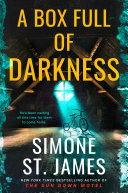
A haiku whispers through abandoned halls:
Childhood ghosts return—
Water remembers secrets,
Love drowns in darkness.
The Weight of Returning Home
There exists a particular terror in returning to the place where your worst nightmares originated, where the walls remember your screams and the floorboards creak with unfinished business. Simone St. James understands this primal fear intimately, weaving it through every page of A Box Full of Darkness by Simone St. James with the precision of a master craftsperson who has spent years perfecting her gothic horror signature. This latest offering from the bestselling author demonstrates not just technical prowess but an emotional maturity that elevates it above standard haunted house fare into something genuinely profound about family, trauma, and the ghosts we carry long after we’ve fled our childhood homes.
The premise itself carries weight: eighteen years after six-year-old Ben Esmie vanished during a game of hide-and-seek, his three older siblings receive an impossible message. The boy wants them to come home. Violet, the hard-edged eldest with a gift for seeing the dead; Vail, the stoic investigator who has built a career chasing unexplained phenomena; and Dodie, the youngest sister who carries her own water-soaked nightmares—all converge on the decrepit family house in Fell, New York, a town so saturated with supernatural malevolence it reads like Stephen King’s Castle Rock crossed with Shirley Jackson’s Hill House.
Atmospheric Precision and Narrative Architecture
St. James demonstrates remarkable restraint in her atmospheric construction. Rather than overwhelming readers with cheap scares or overwrought descriptions, she builds dread through accumulated detail—the way cold air pools in certain hallways, how furniture shifts positions when no one is watching, the clicking sound that precedes manifestations. A Box Full of Darkness by Simone St. James operates on the principle that true horror emerges from the familiar made strange, from the violation of spaces that should offer sanctuary but instead harbor malevolence.
The author’s prose adapts seamlessly between the three sibling perspectives, each voice distinct yet unified by shared trauma. Violet’s sections crackle with defensive anger masking deep vulnerability, while Vail’s chapters maintain a clinical detachment that gradually fractures under supernatural assault. Dodie, perhaps the most compelling narrator, brings an artist’s sensitivity to horror, perceiving beauty even in darkness while remaining acutely aware of danger. This multi-perspective approach creates narrative momentum while allowing St. James to explore how differently trauma manifests across individuals who experienced the same foundational loss.
The pacing deserves particular praise. St. James resists the temptation to rush toward revelation, instead allowing mysteries to accumulate organically. The gradual uncovering of the Whitten family history—the revelation that their house sits on land once owned by this tragic dynasty—provides historical depth that enriches rather than overshadows the contemporary narrative. When the truth about “Sister,” the malevolent presence who has terrorized Violet since childhood, finally emerges, the revelation carries devastating emotional weight precisely because St. James has earned it through careful groundwork.
Character Complexity and Emotional Authenticity
Where A Box Full of Darkness by Simone St. James truly distinguishes itself is in its refusal to simplify its characters or their relationships. The Esmie siblings are not heroic figures embarking on a supernatural adventure—they are damaged adults whose negligent, alcoholic parents left them to raise themselves and their little brother. Their reunion is fraught with resentment, guilt, and the kind of shorthand communication that comes from shared suffering. When they bicker about stolen birthday money or burned dolls, these moments feel lived-in and authentic, grounding the supernatural elements in recognizable human dynamics.
St. James demonstrates particular skill in depicting Violet’s relationship with her teenage daughter Lisette. The mother-daughter tension operates as a parallel to the sibling dynamics, exploring how trauma echoes across generations. Violet’s awareness of her own failures as a mother—her drinking, her emotional unavailability, her inability to escape the patterns established by her own parents—adds layers of complexity to her character that prevent her from becoming a simple protagonist.
The treatment of Dodie’s character arc showcases St. James’ nuanced approach to mental health and artistic temperament. Dodie’s fragility never becomes cartoonish, and her ultimate strength emerges not despite her sensitivity but because of it. Her recurring nightmare of drowning connects to the book’s central mystery in ways that feel organic rather than contrived, demonstrating how our subconscious processes trauma long before our conscious mind can articulate it.
Historical Gothic and Contemporary Horror
The historical elements woven throughout A Box Full of Darkness by Simone St. James elevate it beyond standard contemporary horror into something richer and more textured. The Whitten family tragedy—a young woman forced to pass off her illegitimate son as her younger brother, the shame and rage that culminated in murder—provides context that makes the haunting feel inevitable rather than random. St. James explores how secrets poison not just individuals but entire bloodlines, how land itself can become infected with suffering.
The author’s decision to set the story in 1989 rather than the present day proves inspired. This pre-internet, pre-cell phone era forces characters into isolation when confronting supernatural threats, while the cultural attitudes of the period toward unwed mothers and family shame add resonance to the historical timeline. The temporal distance also allows St. James to explore how recently American culture treated certain traumas as unspeakable, how shame functioned as a suffocating force that destroyed lives.
Critiques Worth Considering
Despite its considerable strengths, A Box Full of Darkness by Simone St. James occasionally stumbles in ways that prevent it from achieving masterpiece status. The middle section, particularly the research sequences where Violet and her reluctant companion Bradley investigate historical records, loses some momentum. While these scenes provide necessary information, they lack the visceral urgency of the house-based sequences. Some readers may find themselves impatient for the siblings to stop investigating and start confronting.
The romance subplot between Vail and Charlotte, the ghost hunter he calls for assistance, feels underdeveloped. While their scenes together crackle with potential, Charlotte disappears from the narrative after a significant supernatural encounter, leaving their relationship thread dangling unsatisfyingly. Given the book’s length and scope, St. James could have either committed more fully to this relationship or eliminated it entirely without significant loss.
Additionally, while the climactic confrontation with Anne Whitten delivers emotional catharsis, the mechanics of the final battle rely heavily on physical combat—baseball bats, golf clubs, and hatchets against a supernatural entity. This approach, while viscerally satisfying, sits somewhat at odds with the psychological horror that dominates the rest of the novel. The shift from atmospheric dread to action-oriented resolution may disappoint readers expecting a more cerebral conclusion.
Thematic Depth and Resonance
What ultimately distinguishes this work is its thematic sophistication. A Box Full of Darkness by Simone St. James explores how love can become as destructive as hate, how the things we do to protect those we care about can harm them irreparably. Anne Whitten’s tragedy resonates precisely because she was both victim and perpetrator, a young woman destroyed by circumstances beyond her control who then destroyed her innocent son. The book refuses easy moral judgments, instead presenting cycles of trauma that ripple across generations.
The title itself, borrowed from Mary Oliver’s poem, encapsulates this nuanced approach. Darkness need not be purely destructive; sometimes confronting it directly, understanding its origins and accepting its presence, offers the only path to healing. The Esmie siblings cannot erase their traumatic past or resurrect their lost brother, but they can finally understand what happened and break the patterns that threatened to consume them.
St. James also explores the concept of chosen family versus biological family with considerable sophistication. The siblings’ devotion to Ben, to the memory of the child they essentially raised together, proves stronger than any attachment to their neglectful parents. Their willingness to face unspeakable horror to find answers about Ben’s fate speaks to bonds forged in adversity, to the family we create when the family we’re given fails us.
A Place in St. James’ Canon
For readers familiar with St. James’ previous works—particularly Murder Road, The Sun Down Motel and The Broken Girls—this novel will feel like a homecoming while offering fresh territory. The author continues her exploration of women confronting supernatural threats while investigating historical mysteries, but A Box Full of Darkness by Simone St. James pushes deeper into family dysfunction and inherited trauma than her earlier works. Where those books focused primarily on female protagonists, this novel’s multi-generational, multi-gender perspective demonstrates growth in scope and ambition.
The Fell setting also allows St. James to build a more comprehensive supernatural landscape than in previous novels. The town itself becomes a character—malevolent, hungry, saturated with death and secrets. Readers may find themselves hoping St. James returns to Fell in future works, as the groundwork laid here suggests rich possibilities for additional stories.
Final Verdict
A Box Full of Darkness by Simone St. James succeeds as both gothic horror and family drama, delivering genuine scares alongside emotional resonance that lingers long after the final page. While not perfect—the pacing occasionally flags, and some plot threads remain frustratingly underdeveloped—it represents mature, sophisticated work from an author at the height of her powers. St. James understands that the most terrifying ghosts are the ones we carry within ourselves, and that sometimes the only way out is through the darkness we’ve spent our lives fleeing.
This novel will satisfy readers seeking atmospheric horror with substance, those who appreciate character depth alongside supernatural thrills. It stands as St. James’ most ambitious work to date, a testament to her evolution as a writer willing to tackle difficult themes without sacrificing the page-turning intensity that made her previous books bestsellers.
Similar Books to Explore
For readers who appreciated A Box Full of Darkness by Simone St. James, the following titles offer complementary experiences:
The Broken Girls by Simone St. James – The author’s earlier masterwork exploring haunted boarding schools and cold cases
Mexican Gothic by Silvia Moreno-Garcia – Atmospheric gothic horror examining family secrets and inherited trauma
The Little Stranger by Sarah Waters – Post-war British gothic exploring class, resentment, and supernatural malevolence
Home Before Dark by Riley Sager – Contemporary family returns to investigate haunted house from their past
The Grip of It by Jac Jemc – Married couple confronts supernatural forces in their new home while their relationship fractures