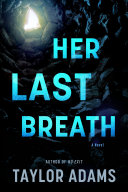
The moment two friends step into the gaping mouth of a cave system in the Cascade Range, Her Last Breath by Taylor Adams transforms from a simple adventure story into a masterclass in psychological horror. What begins as a reluctant caving expedition between best friends Tess and Allie—a claustrophobic legal assistant and a globe-trotting travel influencer—rapidly descends into a nightmare of violence, betrayal, and desperate survival that will leave readers gasping for air alongside the protagonists.
Taylor Adams, whose previous thriller No Exit became a Hulu sensation and garnered international acclaim across thirty-two languages, has built a reputation for crafting high-concept survival stories that grip readers by the throat and refuse to let go. Following the success of Hairpin Bridge and The Last Word, Adams returns with what might be his most ambitious and claustrophobic work yet. The author’s signature style—punchy prose, relentless pacing, and gut-punch revelations—finds its perfect canvas in the oppressive darkness of underground tunnels where screams echo endlessly and help is impossibly far away.
The Anatomy of Confinement
Her Last Breath by Taylor Adams succeeds brilliantly in its most fundamental task: making readers feel the crushing weight of limestone above their heads. The cave system itself becomes a character—hostile, indifferent, and utterly unforgiving. Adams demonstrates meticulous research into caving logistics, from the technical vocabulary (flowstone, anchor bolts, squeeze passages) to the psychological effects of prolonged darkness. When Tess must navigate the “Drainpipe,” a crawlspace barely wider than a coffin, or when characters experience “prisoner’s cinema” (hallucinations brought on by sensory deprivation), the authenticity grounds the horror in uncomfortable reality.
The physical details are unrelenting in their specificity. Adams doesn’t shy away from describing the sensation of being wedged on your stomach in an eighteen-inch gap, unable to turn around, feeling the inexorable pressure of rock on all sides. For readers with even mild claustrophobia, these passages will trigger visceral reactions. The author understands that true terror often comes not from what lurks in the shadows, but from the shadows themselves—from spaces too small, air too thin, and escape routes too distant.
Yet this technical precision never overwhelms the narrative. Adams balances geological authenticity with breakneck pacing, ensuring that readers always understand the stakes without getting bogged down in procedural minutiae. Every detail serves the tension, from the dwindling battery percentages on headlamps to the echo of footsteps that might—or might not—belong to someone who wants you dead.
The Architecture of Suspense
Where Her Last Breath by Taylor Adams truly distinguishes itself is in its structural ambition. The novel unfolds through multiple perspectives—Tess, the alleged attacker Jacob, Allie herself, and a mysterious fourth character named Ethan—each section carefully calibrated to reveal information while withholding crucial truths. This isn’t simply a gimmick; it’s essential to the novel’s exploration of reliability, perception, and the malleability of truth when filtered through trauma and self-interest.
The present-day framing device, featuring Detective Layla Washington interviewing a hospitalized survivor, adds an investigative dimension that elevates the material beyond standard thriller territory. Washington herself is a wonderfully drawn character—an aging detective battling cognitive decline who represents both the reader’s proxy and a crucial moral compass. Her skepticism feels earned rather than convenient, and her gradual piecing together of the truth mirrors our own dawning comprehension.
Adams employs short, punchy chapters that often end on minor cliffhangers, a technique that makes the 400-page novel feel like it’s sprinting toward its conclusion. Some readers may find this structure manipulative, but it’s deployed with such skill that complaints feel churlish. The author knows exactly when to cut away, when to linger, and when to pull the rug out from under reader expectations.
Character Dynamics and Psychological Depth
The relationship between Tess and Allie forms the emotional core of Her Last Breath by Taylor Adams, and it’s here that the novel achieves its most nuanced work. Their friendship, spanning back to high school, feels authentic in its mixture of genuine affection and simmering resentment. Tess, struggling to pay for law school while working as Allie’s assistant, can’t help but feel jealous of her friend’s Instagram-perfect life. Allie, the successful “Keep Calm” travel blogger pulling in fifteen thousand dollars monthly, seems to have everything Tess lacks—confidence, freedom, and financial security.
Adams excels at depicting how power imbalances can poison even the deepest bonds. The small indignities of economic disparity, the subtle ways success can create distance, the jealousy that festers when one friend outgrows the other—these dynamics feel painfully real. Yet the novel never reduces these women to simple archetypes. Both are rendered with complexity and contradiction, their choices driven by understandable (if not always sympathetic) motivations.
The antagonist, Jacob, initially appears as a standard-issue thriller villain—menacing, violent, calculating. However, as his own chapters reveal his perspective, he gains unexpected dimensionality. He’s not excused or redeemed, but he’s made comprehensible, which is somehow more disturbing than if he remained a faceless monster. His relationship with his targets and his own delusions of competence create a portrait of masculine violence that feels both specific and archetypal.
Thematic Resonance
Beneath its propulsive surface, the novel grapples with substantial themes. Survival—not just physical but psychological—becomes a referendum on identity. Who are we when stripped of civilization’s comforts, when faced with choices no one should have to make? The concept of sisu, Finnish for extraordinary determination in the face of adversity, threads through the narrative as characters are forced to discover reserves of strength they didn’t know they possessed.
Her Last Breath by Taylor Adams also interrogates the nature of truth itself. In a situation where witnesses die and survivors control the narrative, whose version of events becomes the “truth”? This meta-textual awareness adds layers to what could have been a straightforward survival thriller. Adams is clearly interested in how stories are constructed, how unreliable our own perspectives become under extreme duress, and how easily we deceive ourselves and others when survival depends on it.
Technology plays an interesting role—the GoPro cameras that capture everything, the dying phone batteries that mock our dependence on devices, the memory cards that might preserve truth or condemn the innocent. In an age of constant documentation, Adams asks what happens when that documentation becomes weaponized evidence.
Where the Rock Face Shows Cracks
Despite its considerable strengths, Her Last Breath by Taylor Adams isn’t without flaws. The multiple-perspective structure, while generally effective, occasionally tips into redundancy. Certain plot points get rehashed from different viewpoints without adding substantial new information, which can feel like padding in an otherwise tight thriller. A few revelations in the final act strain credibility, requiring readers to accept coincidences and timing that feel engineered rather than organic.
The pacing, while mostly exemplary, stutters in the middle section. There’s a stretch where the cave setting’s inherent limitations become constraining for the narrative itself—there are only so many ways to describe being trapped underground before even Adams’s considerable descriptive powers start recycling. Some readers may find the constant ratcheting of stakes exhausting rather than exhilarating, particularly in passages where characters narrowly escape death only to immediately face another lethal threat.
Character decision-making occasionally serves plot convenience over psychological realism. While most choices track logically, a handful of crucial moments require characters to make decisions that feel dictated by thriller-genre requirements rather than genuine human behavior. The novel is at its strongest when characters act in messy, contradictory, authentic ways; it falters slightly when they become pawns moving toward predetermined outcomes.
Craft and Execution
Technical Elements Worth Noting:
Prose style: Adams writes in lean, muscular sentences that favor clarity over ornamentation—perfectly suited to the material’s urgency
Dialogue: Natural and efficient, revealing character through what’s said and what’s pointedly left unsaid
Sensory detail: Exceptional use of sound (echoing drips, distant screams) and touch (cold water, rough stone) to compensate for the darkness-shrouded visual landscape
Research: The caving specifics feel authentic without becoming didactic, suggesting extensive research thoughtfully integrated
Her Last Breath by Taylor Adams demonstrates Adams’s growth as a craftsman. Compared to the relative simplicity of No Exit‘s single-location premise, this book tackles multiple timelines, unreliable narration, and complex character relationships with increased sophistication. His dialogue has sharpened, his action sequences have gained clarity, and his willingness to sit with uncomfortable emotional truths has deepened.
For Readers Seeking Similar Thrills
Her Last Breath by Taylor Adams will particularly resonate with readers who enjoyed:
The Descent (film) for its claustrophobic cave horror and female-centered survival narrative
Ruth Ware’s The Woman in Cabin 10 for its paranoid, confined-space tension and unreliable perspective
Riley Sager’s Final Girls for its exploration of trauma, survival, and the stories we tell ourselves
Paul Tremblay’s The Cabin at the End of the World for its high-concept premise and moral ambiguity
Simone St. James’s The Sun Down Motel for its dual-timeline mystery structure and atmospheric dread
Final Verdict
Her Last Breath by Taylor Adams is an accomplished thriller that delivers exactly what its premise promises while sneaking in unexpected emotional and thematic depth. It’s not a subtle book—Adams isn’t interested in ambiguity when he can offer visceral impact—but it’s an intelligent one that respects its readers enough to construct an intricate puzzle even as it pummels them with suspense.
The cave setting provides not just a backdrop but a crucible where characters are tested and revealed. The multiple perspectives create a kaleidoscopic view of events that shifts and refracts until the final picture emerges. And the central question—who can you trust when your best friend might be your worst enemy—resonates long after the last page.
For readers seeking pure escapist entertainment, the book delivers nail-biting sequences and satisfying twists. For those wanting something more substantial, the exploration of friendship’s dark underbelly and survival’s moral costs provides genuine food for thought. It’s a rare thriller that works on both levels, and while it doesn’t always stick its landings perfectly, the ambition and execution elevate it above typical genre fare.
Adams has crafted a deeply unsettling descent into both physical and moral darkness—one that asks not just whether you’ll survive, but what you’ll become in the process. In the end, that might be the most frightening question of all.