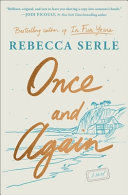
There is a particular ache that comes with reading a novel that understands you better than you understand yourself. Once and Again by Rebecca Serle is that kind of book — a luminous, heartbreaking exploration of what it means to hold the power to undo the past and still choose to move forward. Serle, the New York Times bestselling author of Expiration Dates, One Italian Summer, and In Five Years, has built her career on the delicate architecture of love and time. With this latest work, she delivers her most emotionally ambitious novel yet.
The premise is deceptively simple, almost folkloric. The women of the Novak family each inherit a single do-over — a silver ticket, passed down through generations since a seven-year-old girl named Irina delivered shoes to a mysterious old woman in 1920s Odessa. One chance to turn back the clock and unmake a choice. Lauren’s mother, Marcella, used hers to reverse a fatal car accident that killed Lauren’s father, Dave. Now Lauren, at thirty-seven, still carries her ticket untouched, waiting for a catastrophe worthy of its spending.
The Malibu That Lives Inside You
What Serle does so beautifully in Once and Again by Rebecca Serle is ground the fantastical in the achingly domestic. The Broad Beach house — with its peeling paint, leaking roof, and overgrown fig tree — is as much a character as any member of the Novak family. Serle writes Malibu not as a postcard but as a sensory experience: the icy Pacific that bites at your heels even in summer, the salt-and-Pond’s-cream scent of grandmother Sylvia, the linguini with clams eaten as the sun descends. Every detail feels lived-in, every description earned.
Lauren is not a passive protagonist waiting for magic to save her. She is an accountant who finds comfort in reliability, a woman whose body has refused to give her the family she desperately wants, and a daughter caught in the gravitational pull of a mother defined entirely by fear. When Leo, her warm and hulking husband, lands a job in New York and suggests she spend the summer at the beach house, the stage is set for a homecoming that will unravel everything.
Three Women, Three Relationships with Fear
The generational architecture of this novel is its greatest structural triumph. Serle alternates Lauren’s first-person narration with third-person chapters from Marcella’s perspective, creating a dual portrait of mother and daughter that pulses with tension and tenderness.
Marcella, having spent her silver ticket, now lives inside a fortress of anxiety — orbiting Dave like a security guard, flinching at spilled water, unable to let her husband so much as surf without cataloguing the dangers. Sylvia, the ninety-one-year-old matriarch who will never reveal what she used her own ticket for, remains the family’s unapologetic life force — barefoot, wine in hand, making Mediterranean fish while cracking jokes about Kennedy.
Lauren exists between these two poles, and the novel’s emotional engine is her slow reckoning with which woman she is becoming. The question Serle poses is not simply whether Lauren will use her ticket, but what kind of life she will build around it — whether a safety net becomes a prison.
Where First Love Meets Chosen Love
The return of Stone Morrow — Lauren’s first love, the golden surfer boy who broke her heart when he left for Colorado at twenty-five — introduces a familiar romantic tension that Serle handles with unusual maturity. Their reconnection unfolds through the language they share: surfing at dawn, silence as communication, bodies that remember what words have forgotten.
Yet Serle is careful never to reduce this to a simple love triangle. Stone represents something more dangerous than temptation — he represents the past as refuge. Around him, Lauren doesn’t have to explain her mother’s anxiety or her family’s secret. He was there. He witnessed it all. And that witnessing feels, in the loneliest moments, like a kind of love that Leo, her husband, can never replicate.
The sections with Leo are equally textured. Their marriage is strained not by a lack of love but by the slow erosion of infertility — the shots, the appointments, the hope that refreshes itself with cruel persistence. Serle writes their fertility journey with a rawness that feels drawn from bone:
The false positive from a lingering trigger shot, celebrated and then destroyed in the aisles of a Party City
The final egg retrieval that yields nothing, Leo turning his back in the corner of the recovery room
The way sex becomes both obligation and rebellion, stripped of spontaneity
These moments give Once and Again by Rebecca Serle a weight that transcends its magical premise. The fantasy is almost beside the point. The real question is whether Lauren can stop running from the life she already has.
The Beautiful Cost of Spending Your Miracle
Without revealing the specifics of how the ticket is ultimately used, I will say this: Serle’s handling of its deployment is both surprising and inevitable. The consequences ripple outward in ways that force Lauren into the most honest conversations of her life — with her mother, her husband, and herself.
The novel’s final act is a masterwork of emotional convergence. Lauren must confront what it means to live without a safety net, to accept that some things — her father’s aging heart, her own betrayals, the irrevocable passage of time — cannot and perhaps should not be undone. Serle writes this reckoning with sentences that land like waves:
The revelation that protection and control are not the same thing
That grief, fully felt, is not the enemy of joy but its companion
That choosing forward — imperfect, terrifying forward — is its own kind of magic
Where the Current Falters
For all its emotional depth, Once and Again by Rebecca Serle occasionally lingers too long in its domestic rhythms. The middle section, when Lauren is settling into the beach house routine, loses some momentum as the novel catalogues meals and beach walks with a thoroughness that, while atmospheric, can slow the narrative pulse. Readers eager for the central dilemma to sharpen may find themselves waiting for the plot to catch up with the prose.
Additionally, while Marcella’s third-person chapters provide essential context, they sometimes feel more expository than experiential. We are told about Marcella’s interior life in ways that don’t always achieve the visceral intimacy of Lauren’s narration. The mother-daughter relationship, though central, could have been served by more scenes of direct confrontation earlier in the novel rather than the careful circling that dominates their dynamic until the final act.
Stone, too, remains somewhat opaque. Serle paints him in gorgeous sensory detail — the dimples, the salt-crusted hair, the smell of wax and gasoline — but his emotional interiority is glimpsed rather than explored. He functions more as a mirror for Lauren’s nostalgia than as a fully autonomous character.
Who Should Dive In
This novel will resonate most deeply with readers who love stories about family inheritance — not of wealth, but of fear. Fans of Serle’s previous work will find her signature blend of magical realism and emotional precision, though the scope here is broader and the stakes more grounded in mortality than romance.
Similar Books to Explore
The Invisible Life of Addie LaRue by V.E. Schwab — for its meditation on time, memory, and the cost of immortality
The Midnight Library by Matt Haig — another exploration of alternate lives and the roads not taken
Malibu Rising by Taylor Jenkins Reid — for its sun-soaked family saga and coastal atmosphere
The Time Traveler’s Wife by Audrey Niffenegger — for love stories shaped by temporal displacement
Tomorrow, and Tomorrow, and Tomorrow by Gabrielle Zevin — for its examination of partnership across decades
One Italian Summer by Rebecca Serle — for readers who want more of Serle’s magical realism
Final Verdict: A Novel That Trusts the Tide
Once and Again by Rebecca Serle is, at its heart, a book about the terrifying beauty of forward motion. It asks what happens when the women who can rewrite history choose, instead, to live with it. Serle has written a novel that tastes like salt water and reads like a prayer — imperfect in places, yes, but profoundly alive. The magic here is not in the silver ticket. It is in the staying.