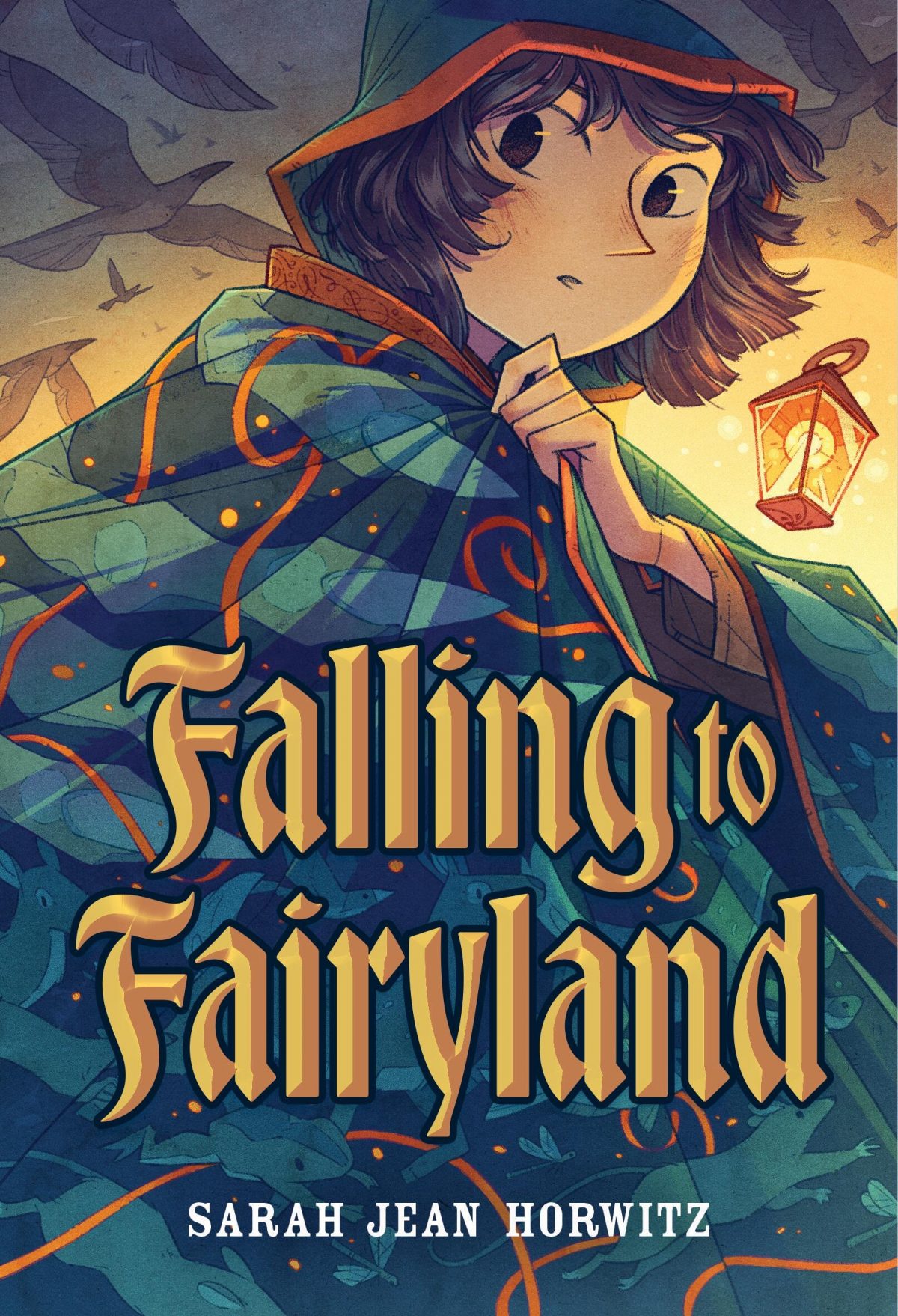
The working title of my upcoming middle grade fantasy novel, Falling to Fairyland, was originally a lot less magical-sounding. From day one of its inception as a baby idea to pretty much the finished product, I called the book Cricket the Ward. It doesn’t exactly roll off the tongue, I know. I also knew that a lot of people, especially younger readers, might not even know what a “ward” was. Wiser heads than mine prevailed and the title was changed to something far more reader-friendly and no less accurate, but I often still called the book by its original title in my head, and I started to wonder why that was. I think it’s because that at least at the beginning of the novel, my characters aren’t ready to fall anywhere, least of all into the adventure they’re about to have.
My main character, Cricket, has lived nearly his entire life as a ward – in his case, as a human child under the guardianship of a powerful fairy sorceress. Cricket is a changeling – a human child stolen from our world and taken to Fairyland. The only life Cricket’s ever known is a secluded one, confined mostly to the walls of the Fairy Witch’s tower, where he spends his days serving as her most trusted spy. At the beginning of the novel, when another character asks who he is, Cricket doesn’t merely say his name. He introduces himself as “Cricket, ward of the Fairy Witch of the North.” Hence Cricket the Ward. Cricket is fully defined by his relationship with – and subservience to – the Fairy Witch.
But after a mysterious prophecy throws Cricket’s status in the Fairy Witch’s court into doubt, he’s forced to leave the tower and go on a quest to prove his worth to her. And as he journeys through Fairyland and meets its various denizens – both friend and foe – his unshakable faith in his identity as “Cricket the ward” is challenged. Cricket has his own secret power, which the Fairy Witch has insisted he keep hidden for all these years: he is a shapeshifter. For the first time, he’s given the opportunityto explore that power on his own, to use his gifts not just in service of the Fairy Witch, but for himself and the friends he makes along the way. Over the course of the novel, others begin to call Cricket “Changeling” with a capital ‘C.’ With his ability to transform into whatever person or creature he desires, he is not just a changeling human, not just a boy, not just a ward – he is a changeling who changes. That’s real power, and it comes from within.
As I wrote the book that I called Cricket the Ward, I was going on a journey of my own. Just as Cricket was questioning his identity, I, too, was questioning mine. It’s no secret that Falling to Fairyland is fundamentally a story of queer identity. I’ve been comfortable with the labels of “asexual” and “biromantic” I chose for my own queer identity for many years now. But writing this novel forced me to examine the fact that, while I was pretty confident about my sexual identity, I had just as much to explore about my gender identity as Cricket did. The book is very much done now, but my journey – and Cricket’s – isn’t over. I’m not exactly sure which label is right for me (though I think I lean more towards the agender part of the spectrum), but writing Falling to Fairyland made me realize that there’s no pressure to decide – not right away, and maybe not ever. At the end of the novel, Cricket doesn’t immediately replace being “the ward” with something else. He’s just Cricket, and he’s excited for where the rest of his journey will take him. I am, too.
I also realized that the title change to Falling to Fairyland was better from more than just a marketing perspective. Because if I’d kept the title Cricket the Ward, then in a small way, I would be keeping Cricket defined by a label that no longer suits him by the end of the book. By letting that label go, I’m letting Cricket free, too.
In the introduction of the book, one of the narrators explains the experience of falling to Fairyland from the human realm. Though the narrator gives plenty of advice, they ultimately end with the line, “Sometimes, falling is the most any of us can do.” What I hope the rest of the book shows is that while falling can be painful and messy and scary, it can also be beautiful and joyous and empowering. I hope my readers will take a moment to feel the sun against their face and the wind rushing through their hair as they take the plunge into these pages and go on their own journey through the fairy realm. Because never fear – I wrote this book to catch you when you land.
Sarah Jean Horwitz grew up next door to a cemetery and down the street from an abandoned fairy-tale theme park, which probably explains a lot. Her love of storytelling came from listening to her mother’s original “fractured” fairy tales, a childhood spent in community theater, and far too many rereads of her favorite fantasy books. She now lives with her spouse near Boston, Massachusetts, in a neighborhood sadly lacking in witches’ towers. Find Sarah Jean online at sarahjeanhorwitz.com.