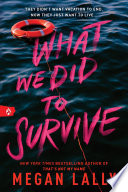
Spring break in Mexico. A private sailboat. Four teenagers. And a storm — not just in the sky, but on the boat itself.
What We Did to Survive by Megan Lally doesn’t ease you into danger. It lures you into the sun first. Salt air, smoothie stands, a hopeless decade-long crush, and a best friend who sparkles wherever she goes. Then, chapter by chapter, it strips away every safety net until the four teens at the center of the story are left with only two questions worth asking: what will you do to get home alive? And what does surviving cost?
For readers already familiar with Lally’s previous thrillers — That’s Not My Name and No Place Left to Hide — this book marks a recognizable evolution. The pacing has tightened. The stakes have become oceanic. And her instinct for putting characters in physically and morally impossible situations has never been sharper.
The Setup: Slow Burn Before the Fire
Hannah is not the kind of girl who takes risks. She is a lifeguard training to become a trauma nurse, the quiet axis around which louder people orbit. Her best friend Emmy Cole is all golden hair, impulsive charm, and infectious joy. Emmy’s older brother Jackson — who Hannah has quietly loved for ten years — barely speaks to her, for reasons neither of them seems ready to name.
When Emmy’s new resort romance, the wealthy and slick Bennett Mulholland, arranges a private sailing charter for their last day in Puerto Vallarta, the red flags appear almost immediately. All the official charters are docked because of incoming storms. The captain they hire operates out of a boat called The Be-Yacht-Ch. And Hannah notices things nobody else wants to.
This opening stretch runs closer to contemporary romance than thriller, and it asks for patience. The social dynamics among the group are drawn well, and the chemistry between Hannah and Jackson is quietly aching. But readers arriving for the survival thriller promised on the cover might find themselves restless before the storm clouds actually arrive.
When they do, What We Did to Survive by Megan Lally shifts registers completely and does not look back.
The Thriller Takes the Wheel
Once the four teenagers find themselves stranded in the open ocean, Lally’s writing transforms. The prose quickens. Chapters end mid-breath. Hannah’s nursing instincts and survival training — so carefully seeded in the opening — become the engine the entire plot runs on.
What separates this book from a standard thriller is the layered threat structure. The storm is terrifying, yes. But it is not the most dangerous thing on the boat. That would be Bennett Mulholland, whose charm curdles slowly and then all at once into something far more frightening. Lally is careful not to reveal too much about who he really is before the reader has also had time to be fooled by him. That patience pays off.
Hannah makes a decision early in the crisis that defines her character completely: she dives into churning water in the middle of a storm to search for someone who probably cannot be saved. She does it because she is a lifeguard, and that is simply what you do. What We Did to Survive by Megan Lally is ultimately a book about people who keep doing what they were built to do, even when everything around them has collapsed.
Jackson proves himself steady in exactly the way Hannah always suspected he might be, without becoming a fantasy. He makes mistakes. He hesitates. His strengths are real, and so are his limits.
What the Book Does Well
There is genuine craft in how Lally distributes tension across the survival sequences. The physical details accumulate — broken mast, flooded cabin, no radio, failing phones, shrinking food — with a logic that feels researched rather than invented. Hannah’s responses to each crisis come from her training, not from plot convenience, and that makes them satisfying in a way that survival fiction often is not.
Standout strengths throughout the novel include:
Hannah’s interiority. She is anxious, competent, and wryly funny even in mortal danger. Her narration carries the book.
The moral complexity of survival decisions. Several scenes ask genuinely difficult questions about what you owe someone who has caused harm, even when they are also in danger.
Emmy’s characterization arc. What initially reads as frustrating compliance resolves into something considerably more surprising and satisfying.
The third-act pacing. Once the group reaches land, Lally does not let up. She trades one set of dangers for another without the story ever feeling mechanical.
Where the Seams Show
A four-star average is an honest measure of a book with real strengths and equally real limitations, and What We Did to Survive by Megan Lally earns that assessment fairly.
The areas that don’t fully land:
Ben’s characterization lacks dimension. He works effectively as a threat, but his turn from charming to menacing is swift enough that the middle stages feel skipped.
The romance is earnest but awkwardly timed. Jackson and Hannah’s relationship reaches its emotional peak inside a survival crisis, which gives their scenes an urgency that occasionally slides into melodrama.
The opening pacing. The resort chapters do necessary character work but run slightly longer than the thriller’s momentum can afford.
The ending leaves several threads deliberately open. This is a choice, not an oversight — but readers who want closure on every front may find the final pages unsatisfying.
The Real Question at the Center
The title, What We Did to Survive, is not only about lifeboats and signal fires. It is about choices made under pressure — what you protect, what you sacrifice, what you refuse to do even when survival might seem to justify it. Hannah’s moral compass is tested repeatedly, and Lally never makes the answers easy.
This is the book’s most genuine achievement. It trusts its protagonist to have a conscience even when that conscience costs her. In a subgenre that can sometimes reduce its characters to action and reaction, that restraint matters.
If You Liked This, Read Next
That’s Not My Name by Megan Lally — the author’s debut, built around identity, fear, and a relentless chase narrative
No Place Left to Hide by Megan Lally — another propulsive thriller for fans of her writing style
One of Us Is Lying by Karen M. McManus — group dynamics under pressure, a killer in plain sight, and a narrator you can’t quite pin down
A Good Girl’s Guide to Murder by Holly Jackson — a YA mystery with a fiercely determined female lead and layer-by-layer reveals
The Inheritance Games by Jennifer Lynn Barnes — for readers who want their thrillers with sharp wit and a puzzle at the center
Final Word
What We Did to Survive by Megan Lally is the kind of book that makes you glance out the window halfway through and feel grateful for solid ground. It is not without flaws — the early pacing tests patience, and the antagonist could use more interior life. But Lally writes Hannah with enough clarity and warmth that even the rough patches hold your attention.
Read it for the survival sequences. Read it for Emmy’s unexpected depth. Read it because it asks a question worth sitting with long after the last page: when everything is stripped away, who do you choose to be?