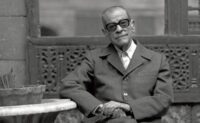
The Egyptian novelist Naguib Mahfouz was the Arab world’s most prominent literary figure. Neglected in the west, modern Arabic literature achieved international recognition when Mahfouz was awarded the Nobel Prize in 1988.
This post may contain affiliate links that earn us a commission at no extra cost to you.
Naguib Mahfouz: His Life
Naguib Mahfouz was born in Cairo, Egypt in 1911. He started writing at the age of seventeen. His debut novel was published in 1939. By the time of the July 1952 Egyptian Revolution, he had written eleven more novels.
The Cairo Triology, Bayn al Qasrayn, Qasr al Shawq, Sukkariya (in English Palace Walk, Palace of Desire and Sugar Street) published in 1957 made him famous throughout the Arab world. A novel on the grand scale of some 1,500 pages, the trilogy deals with three generations of the Abd al-Jawad family and extends from 1917 to just before the end of WW2.
With Children of Our Alley (1959), he began writing in a new vein that frequently concealed political judgements under allegory and symbolism. Works of this second period include the novels, The Thief and the Dogs (1961), Autumn Quail (1962), Adrift on the Nile (1966), and Miramar (1967), as well as several collections of short stories.
Until 1972, Mahfouz was employed as a civil servant at the Ministry of Culture. The years since his retirement from the Egyptian government saw a move to more experimental work.
He published 35 novels, over 350 short stories, 26 screenplays, hundreds of op-ed columns for Egyptian newspapers, and seven plays over a 70-year career,
His last novel was Qushtumar (1988) and his last published work was another collection of short stories, The Seventh Heaven (2005) which dealt with the afterlife. He wanted, he observed, to believe that something good would happen to him after his death.
Neither the fame nor the considerable monetary reward afforded by the Nobel Prize altered his life. He continued to live in his modest flat in the middle-class district of Giza with his wife and two daughters and changed nothing in his daily routine. A lifelong Cairo resident, he remained until the day of his death in 2006, a modest man with a ready smile and that sense of humour for which Egyptians are famous.
Best Naguib Mahfouz Books to Read in English
Three Novels of Ancient Egypt
Naguib Mahfouz’s first three novels, all set in ancient Egypt, which skillfully explore recurring themes within human relationships: the balance between destiny and individual agency, the sanctity of the bonds to the land and religion, and the constant power struggles that affect human lives at multiple levels.
In Khufu’s Wisdom, translated by Raymond Stock, Pharaoh Khufu is battling the Fates. At stake is the inheritance of Egypt’s throne, the proud but tender heart of Khufu’s beautiful daughter Princess Meresankh, and Khufu’s legacy as a sage, not savage, ruler.
Rhadopis of Nubia, translated by Anthony Calderbank, follows the powerful love that grows between Rhadopis, a courtesan whose ravishing beauty is unmatched in time or place, and youthful, headstrong Pharaoh Merenra, worshiped by his people as a divine presence on earth, against the background of the high politics of Sixth Dynasty Egypt.
Finally, in Thebes at War, translated by Humphrey Davies and written in 1937 – 1938 when Britain and Turkey held sway over Egypt, Mahfouz dramatically depicts the Egyptian people’s undying loyalty to their land and religion and their refusal to bow to outside domination. After two hundred years of occupation, the Hyksos leader in his capital in northern Egypt tells Pharaoh in the south that the roaring of the sacred hippopotami at Thebes is keeping him awake at night and demands that they be killed, galvanizing Egypt into hurling its armies into a struggle to drive the barbarians from its sacred soil forever.
Midaq Alley
Widely acclaimed as Naguib Mahfouz’s best novel, Midaq Alley brings to life one of the hustling, teeming back alleys of Cairo in the 1940s. From Zaita the cripple-maker to Kirsha the hedonistic cafe owner, from Abbas the barber who mistakes greed for love to Hamida who sells her soul to escape the alley, from waiters and widows to politicians, pimps, and poets, the inhabitants of Midaq Alley vividly evoke Egypt’s largest city as it teeters on the brink of change. Never has Nobel Prize-winner Mahfouz’s talent for rich and luxurious storytelling been more evident than here, in his portrait of one small street as a microcosm of the world on the threshold of modernity.
The Cairo Trilogy: Palace Walk, Palace of Desire, Sugar Street
The Nobel Prize-winning writer’s masterwork is the engrossing story of a Muslim family in Cairo during Britain’s occupation of Egypt in the early decades of the twentieth century.
The novels of The Cairo Trilogy trace three generations of the family of tyrannical patriarch al-Sayyid Ahmad Abd al-Jawad, who rules his household with a strict hand while living a secret life of self-indulgence.
Palace Walk introduces us to his gentle, oppressed wife, Amina, his cloistered daughters, Aisha and Khadija, and his three sons – the tragic and idealistic Fahmy, the dissolute hedonist Yasin, and the soul-searching intellectual Kamal.
Al-Sayyid Ahmad’s rebellious children struggle to move beyond his domination in Palace of Desire, as the world around them opens to the currents of modernity and political and domestic turmoil brought by the 1920s.
Sugar Street brings Mahfouz’s vivid tapestry of an evolving Egypt to a dramatic climax as the ageing patriarch sees one grandson become a Communist, one a Muslim fundamentalist, and one the lover of a powerful politician.
Children of the Alley
Naguib Mahfouz guides us on a journey through the history of the tumultuous alley belonging to a delightful – and sometimes diabolical – Egyptian family: the descendants of a man named Gabalawi. We accompany them in their struggles to right their wrongs, to eke out a better existence for themselves and their cohorts – and we discover a second, hidden, and daring narrative: the spiritual history of humankind. From the supreme feudal lord who disowns one son for cruel pride and puts another to the test, to the savior of a succeeding generation who frees his people from bondage, we find the men and women of a modern Cairo neighborhood unwittingly reenacting the lives of their holy ancestors: the “children of the alley.”
Miramar
This highly charged fable set in Alexandria, Egypt, in the late 1960s, centers on the guests of the Pension Miramar as they compete for the attention of the young servant Zohra. Zohra is a beautiful peasant girl who fled her family to escape an arranged marriage. She becomes the focus of jealousies and conflicts among the Miramar’s residents, who include an assortment of radicals and aristocrats floundering in the wake of the Egyptian revolution. It becomes clear that the uneducated but strong-willed Zohra is the only one among them who knows what she wants.
As the situation spirals toward violence and tragedy, the same sequence of events is retold from the perspective of four different residents, in the manner of Akira Kurosawa’s Rashomon, weaving a nuanced portrait of the intricacies of post-revolutionary Egyptian life.
If you enjoyed Naguib Mahfouz: His Life, check out 10 Best North African Books to Read