Crime Scene: May 1, 1992
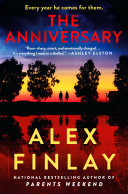
Some thrillers chase you through a single weekend. The Anniversary by Alex Finlay stretches the hunt across ten years, returning every May 1st to two seventeen-year-olds whose lives split apart on a single Nebraska night in 1992. Quinn Riley, the bookish kid from the wrong side of Monarch, swings a punch that ends in a skull crack and a ride to juvie. Jules Delaney, golden girl of the high school food chain, climbs into her car at a corner store and feels a stranger’s arm wrap around her throat from the back seat.
That stranger is the May Day Killer. Five girls, five years, one date. The cops have nothing.
What Finlay does with this premise is the genre equivalent of slow-cooking. He lets a decade simmer, returning every May 1st with snapshot chapters that double as a long, slow-burning investigation. By Year Five we are in a courtroom. By Year Eight at a fundraiser. And by Year Ten in a graveyard staring at a stone that reframes the whole book. It is patient plotting in a category that usually mistakes velocity for skill.
The Two-Soul Spine
The novel pretends to be a manhunt and turns out to be a love story tracked across a calendar. Quinn carries Hemingway and Fitzgerald in his pockets like talismans, joins the Army out of obligation, comes home limping from Somalia, and tries to build a P.I. career while picking at the scab of his mother’s unsolved murder. Jules drops out of college, models in Milan, snorts cocaine in a place ironically called Hotel Go-See, and slowly builds a missing-persons nonprofit called Find Them.
They cross paths on May 1st most years. Sometimes for a coffee. Sometimes a courthouse run-in. And sometimes a fleeting embrace. Sometimes for nothing at all. Finlay trusts the reader to feel the gravity even when his characters spend a year apart. The romantic structure here owes more to The Time Traveler’s Wife and One Day than to most serial killer fiction, and that is the thing that gives the book its strange, aching pull.
What the Author Gets Right
Finlay writes in propulsive present tense, third person, swapping between Jules, Quinn, a Bureau agent called Jack, and the killer’s own coiled second-person passages. The voice changes when the camera changes, and the period details feel lived rather than researched. Pearl Jam tickets. Hagers liquor store. Kris Kross on a tape deck. A faint Y2K hum later on. Anyone who was a teenager in 1992 will catch the texture instantly.
A few elements stand out:
The May 1st structure works as a metronome. Each yearly section opens with a date stamp and a small cast shift. You feel the calendar’s pressure even on the quiet pages.
Quinn’s reading life is real character work, not literary garnish. References to A Separate Peace, The Great Gatsby, The Sun Also Rises, and Italian poet Giacomo Leopardi’s “L’infinito” thread through the story because Quinn lives in books.
Trauma is handled obliquely. Jules narrates her assault the way many survivors actually do, with gaps and side glances. The book respects her interiority instead of turning her pain into a set piece.
The survivor ensemble earns its keep. Lucy, the goth fellow Lucky One who later becomes “Lucy Lawless” in the tabloids, and Carrie, the megachurch daughter, give the small group real range. Their booth-banter is one of the strongest registers in the book.
Modus Operandi: The Prose
Finlay’s sentences are short, declarative, almost cinematic. Scenes end on small punches. Chapters average eight pages. He lets ordinary detail carry weight: a soggy egg salad sandwich, an Aqua Net halo, a Timex with a cracked face. There is restraint at the line level even when the plot is at its loudest, and that restraint is what keeps the book from tipping into melodrama.
There is also humor here, mostly dry, mostly through Lucy. The book knows when to laugh. It also knows when to shut up, which a lot of modern thrillers do not.
Forensic Examination: Where the Case Files Get Thin
A four-star book is not a five-star book, and The Anniversary by Alex Finlay has seams that show in good light.
Coincidence as engine. Quinn keeps stumbling onto evidence through conversations that should not be happening. A nursing home retiree. A flower shop delivery. A hairstyle on a school bus. Once or twice is destiny. Four or five times is a screenwriter’s convenience.
Side trips that wander. The Somalia stretch, especially Quinn’s village days with Giuseppe’s sister Alessia, is some of the most beautifully written prose in the book and also the section most disconnected from the central manhunt. It pays off thematically late, but readers may feel the air leak out of the May Day plot for a stretch.
The reveal asks for a leap. Without spoiling the killer’s identity, the late-stage twist requires the reader to retrofit earlier scenes. Some will buy it cleanly. Others will go back, frown, and feel the nudge.
A few characters thinned by archetype. Brad, the high school jerk, never becomes a full person. Holly, Quinn’s girlfriend across several years, deserves more interior life than the plot gives her.
None of this knocks the book off its rails. These are the gaps between excellent and great.
Closing Argument
The Anniversary by Alex Finlay ends with a graveside scene, a microfiche machine, and an interrogation in a diner booth I will not describe further. What lingers afterward is not the killer’s identity at all. It is the shape of two lives drawn close, pushed apart, and slowly reeled back together by a date neither of them chose.
Finlay has been mining this small-town territory for a while across earlier novels including Every Last Fear, The Night Shift, What Have We Done, If Something Happens to Me, and his 2025 bestseller Parents Weekend. The Anniversary by Alex Finlay is the most ambitious of them, a serial killer novel sneaking a love story past the security checkpoint.
Case Files: If You Liked This, Investigate These
Every Last Fear by Alex Finlay, his debut, for similar small-town Midwestern dread and a sibling-driven core
Pretty Girls by Karin Slaughter, for a decade-spanning serial killer story rooted in family
All the Missing Girls by Megan Miranda, for time-jumping structure and a small-town disappearance
Final Girls by Riley Sager, for survivors of violence who refuse to stay quiet
In the Woods by Tana French, for an investigator stalked by his own past
Razorblade Tears by S.A. Cosby, for blue-collar grief and grown men hunting answers
Bent Road by Lori Roy, for Midwest noir with a hard moral center
The Last Time I Lied by Riley Sager, for a survivor returning to the scene years later
The book finds its real subject in the quiet places between the bloody ones. The Anniversary by Alex Finlay is the kind of novel you slide across a counter to a friend with one sentence: trust me, just read it.