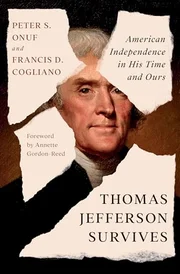
“Jefferson survives.” These, it is said, were John Adams’ last words, as he died—as did Jefferson—on July 4, 1826, exactly 50 years after the signing of the Declaration of Independence. That document, write historians Onuf and Cogliano in this distillation of their popular seminar for schoolteachers, was heavily edited by a committee of the Continental Congress, introducing certain ambiguities and deleting a key passage in which Jefferson lay blame for slavery on King George III—editing that, Jefferson believed, “fatally compromised the integrity of the Declaration [Congress] finally adopted.” The irony, of course, is that Jefferson himself was slaveholder to the end of his life, which has led to his being canceled in many progressive quarters, leaving it to the right wing to claim Jefferson as their own. This is overreach, the authors suggest, for although Jefferson held out for states’ rights and mistrusted a too-powerful central government, he, of course, supported the creation of a federal union in the first place, one that constituted a nation. Whether on the left or right, the authors worry that Jefferson “seems to have lost his relevance.” They argue that Jefferson’s central question—“Are we capable of governing ourselves?”—remains central today, particularly in a time of authoritarianism and a seemingly imperial government in the place of a polity whose power derives from the consent of the governed. The authors emphasize other aspects of Jeffersonian thought, including the thesis that it is up to each generation to preserve the nation for the generations to follow: “The success and survival of America’s republican experiment depended on the spirit that animates each generation and brings abstract principles to life.”
Categories
THOMAS JEFFERSON SURVIVES