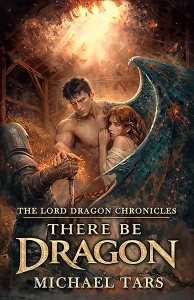
Synopsis:
THERE BE DRAGON is an adult epic fantasy with slow-burn romance in a sprawling world of magic, greedy demigods, and dark prophesies.
When the people of magical Kalador prayed for a savior, they summoned Kwe—a battle-scarred soldier from a futuristic Earth who is plagued by memories of his violent past. He’s told that an ancient Dragon’s spirit resides within him and that together they’re destined to protect the realm from hungry demigods plotting Kalador’s demise.
Now, voices of several Dragons crowd Kwe’s mind, each with their own agenda, all threatening to take over. Cut-throat court politics and strange magic, assassination attempts and threats of imminent war are bad enough; it’s worse to fall in love when romance is impossible. Though try explaining that to the amorous dragon within…
Common-born Kira didn’t expect to become the Chosen. Now she must bind the new Lord Dragon’s soul to Kalador. If only he’d see not just her duty, but also her love.
With threats multiplying, and Kira’s life on the line, Kwe’s only choice is to embrace the dragons—without losing himself in the process. He might be a pawn in some demigod’s secret game, but he won’t be broken or controlled.
With a nefarious demigod plotting from the bottom of the ocean, will Kwe’s newfound
Dragon powers and battlefield experience be enough to keep the country and those he loves safe?
An adult fantasy romance for fans of romantasy, dragons, forbidden romance, and mysteries demanding to be solved.
Favorite Lines:
“The hardest lies to see are those you tell yourself.”
“Nothing had changed, yet everything was different.”
“Wars were costly. Even for the victor.”
My Opinion:
I received a copy of this book from the author in exchange for my honest opinion.
There Be Dragon opens like a futuristic military science fiction novel before abruptly turning into something completely different. Lieutenant Colonel Kwe is leading a raid in a technologically advanced version of Earth when he sacrifices himself to save his best friend and expects to die. Instead, he wakes up in the snow beneath a perfectly blue sky, surrounded by three girls who are convinced they have just summoned their country’s new Lord Dragon. Kira, Maya, and Kira’s younger sister Nora have been sent out as part of an ancient ritual meant to find Kalador’s new divine protector, and through either fate, magic, or some very enthusiastic pompoms, they find Kwe. It’s a strange setup, and the collision of genres gives the story an unusual starting point. Kwe tries to analyze everything through the eyes of a highly trained soldier from an advanced civilization, while everyone around him interprets his technology through the perspective of a world where magic and gods are completely real.
What I found more interesting than the actual “man from the future becomes a dragon” premise was the way Kwe reacts to the society he’s landed in. Kalador treats him as an all-powerful ruler almost immediately, but he is increasingly horrified by many of the traditions everyone else considers normal. This is especially true when it comes to the treatment of women. Kira was facing marriage to an abusive man, Maya’s father was essentially negotiating a price for her, and all three girls are suddenly told that they now “belong” to Kwe as his Maidens. Kwe’s refusal to simply accept that arrangement creates an interesting tension within the story. Even when he’s attracted to Kira, he is conscious of the fact that her society has given her very little real choice, and he doesn’t want his position as Lord Dragon to become another way for someone else to control her. That complicates their developing relationship, particularly as Kira tries to establish that what she wants is actually her own decision.
Kwe also begins challenging Kalador’s traditions in smaller ways. He isn’t only interested in defeating enemies with futuristic weapons or demonstrating how technologically superior his world was. He cooks, insists that his Maidens eat with him, recruits women as fighters and bodyguards, teaches the girls to defend themselves, and treats servants and commoners with a level of respect that repeatedly confuses the people around him. These moments help establish the kind of ruler Kwe intends to be, although I did find there was sometimes a disconnect between the story’s criticism of Kalador’s treatment of women and the way its female characters were presented elsewhere in the narrative. One particularly meaningful moment comes when Kwe meets Moira, the cook who cared for Kira and Nora when their own family failed them. Rather than dismissing her as a servant, Kwe kneels before her, thanks her, and promises to care for “her girls.” It’s a relatively small moment compared to the larger political conflicts surrounding Kalador, but it reveals quite a bit about how Kwe sees the people who have unexpectedly become part of his life.
There is plenty of action, magic, political maneuvering, romance, and humor, with the relationships between Kwe, Kira, Maya, and Nora forming a significant part of the story’s emotional foundation. Kwe begins the book mourning a life he believes he has lost, but over time, Kalador stops feeling quite so much like somewhere he has accidentally landed and starts becoming somewhere he genuinely wants to protect. The ending leaves the larger story unfinished, particularly when it comes to Leviathan and the threats gathering around Kalador, while still bringing Kwe’s personal journey in this installment to an important turning point. By the final pages, the people gathered around him represent the connections he has formed in a world that was completely foreign to him when the story began.
I do want to flag that there are some parts of this book that are, in my opinion, problematic. While I appreciated the novel’s emphasis on consent and Kwe’s efforts to challenge Kalador’s treatment of women, I sometimes found the repeated focus on the women surrounding him and their attraction to him excessive. There were also a few adult-oriented jokes involving a much younger character that I personally found uncomfortable and unnecessary. These elements occasionally distracted me from what I thought were the more interesting aspects of the story, particularly the clash between Kwe’s futuristic values and the traditions of his new world. Because these elements may be significant for some readers, I think they are worth mentioning as part of my overall experience with the book.
Summary:
Overall, There Be Dragon is a genre-blending portal fantasy about a futuristic soldier who finds himself transported into a medieval world and mistaken, or perhaps correctly identified, as its newly summoned Lord Dragon. As Kwe tries to understand his new powers and the Dragon sharing his consciousness, he also has to navigate a society whose traditions surrounding class, gender, marriage, and political power often conflict sharply with his own values.
I think this may appeal to readers who enjoy portal fantasy and isekai-style stories, powerful protagonists, science fiction mixed with traditional fantasy, dragons, political worldbuilding, found family, and stories where a modern or futuristic character introduces new ideas into a less technologically advanced society. Readers should also be aware that the book contains a significant romantic and sexual component, including some material that may be uncomfortable for certain audiences. The story also deals with darker subjects involving abuse, exploitation, sexual violence, assassination attempts, and war.
You can find the book trailer here
Check out There Be Dragon here