When authors picture a publishing service going wrong, they usually picture a missing payment. A statement arrives, the money does not, and eventually somebody sorts it out. That is the optimistic version.
The realistic version is that a failed publishing service takes several things at once, and money is the one you are most likely to get back. What tends to go missing for longer is access: to the account the book is listed under, to the files it was built from, to the identifier the trade uses to order it, and to the ability to put it on sale anywhere else while the situation is unresolved.
August 2026 supplied a fresh example. The Bookseller carried the news on the 13th: a UK intermediary that sat between indie authors and the wholesaler Gardners had gone under, with earnings unpaid and the Society of Authors stepping in to help writers work out where they stood. Establishing the full picture in any case like that takes months, and insolvency on its own proves nothing about anyone’s conduct. The shape of what follows, though, is predictable enough to set out in advance.
Publishing service failures are more common than they look
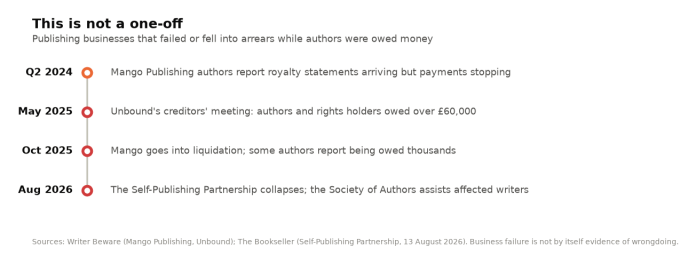
Individual collapses make the trade press one at a time, which makes each feel exceptional. Put them in order and the pattern is duller and more useful.
Sources: Writer Beware on Mango Publishing and Unbound; The Bookseller on the August 2026 collapse.
Writer Beware documented Mango Publishing authors receiving royalty statements while payments stopped, an issue traced back to the second quarter of 2024, with liquidation following in October 2025 and some authors reporting thousands outstanding. A creditors’ meeting for Unbound in May 2025 recorded authors and rights holders owed more than £60,000 between them.
Two things are worth noting. First, these are not all vanity operations; several are houses authors reached by the routes described in the pros and cons of traditional publishing. Second, in almost every case the earliest warning sign was the same, and it was not a press release. It was statements continuing to arrive while payments quietly stopped.
Stage one: the silence
The first phase of a failing publishing service rarely announces itself. Payments slip from the usual date to a week late, then a month. Support tickets take longer. Somebody has left and not been replaced. The explanation, when it comes, is a systems migration or a banking issue.
This is the stage at which authors have the most power and use the least of it, because nothing has formally happened yet and nobody wants to be the difficult client. It is also the only stage at which a negotiated exit is straightforward. A company that is still trading can hand back files, transfer an account and agree to terminate. A company in a formal process usually cannot, even if it wants to.
If your payments are late twice in a row, stop waiting politely and start asking in writing.
The warning signs that actually mean something
Not every wobble is a collapse. Small companies have cash-flow months, and staff leave everywhere. The signals worth acting on are the ones that show the reporting and the money coming apart from each other.
Statements that keep arriving on time while payments do not is the clearest of them, because it means the system that calculates what you are owed is still running and the one that pays it is not. A refusal to show underlying platform reports, when it was previously routine, is another. So is a change in who signs the emails, or an invoice suddenly issued by a differently named legal entity. A publishing service that starts asking for fees earlier in the cycle, or offering a discount to pre-pay next year’s services, is telling you something about its working capital whether it means to or not.
None of these prove anything on its own. Two of them together justify a written request for a reversion and an account transfer while everyone can still act.
Stage two: the freeze
Once a formal insolvency process begins, control passes to an appointed office holder whose duty is to the creditors as a whole. From that moment, several things become true at once.
Your listings keep selling. This surprises people. Books distributed under a company’s account do not automatically vanish when the company fails, which means readers may go on buying while the income accrues somewhere you cannot reach.
Your contract becomes an asset. Publishing and distribution agreements have value, and an office holder may be entitled to sell them to raise money for creditors.
Your money joins a queue. This is the part worth understanding properly, because it is where most authors’ expectations break.
A general illustration of insolvency priority. Terminology and detail vary by country; this is not legal advice.
Why your reversion clause may not rescue you
Most well-drafted author agreements say that rights revert automatically if the company enters liquidation, administration or receivership. Authors’ organisations recommend exactly that language, and you should still insist on it.
Writer Beware’s reporting on recent failures is blunt about the limits of that protection. Insolvency law tends to override what the parties wrote down. An agreement with commercial value is something the office holder may be able to sell, the duty runs to the body of creditors rather than to any individual author, and a reversion signed in the weeks before a filing can be attacked as having come too late to count. Writers rank among the unsecured, behind the cost of running the process, behind lenders holding security, behind preferential claims. Whatever survives that descent is what the tier receives.
The practical lesson is not that the clause is worthless. It is that the clause is a tool for the period before insolvency, not after. A reversion you negotiate while a publishing service is still trading is worth a great deal. One you try to enforce afterwards may be worth very little.
There is a deadline dimension too. Where a formal process exists, creditors normally have a limited window to submit a claim, and it is easy to miss while waiting for news. Find out what applies in the relevant jurisdiction early rather than late.
Stage three: what you can and cannot do
Authors caught in these situations usually want to act immediately, which is right, but the useful actions and the tempting ones are not the same.
Do this now
Do not do this yet
Screenshot every dashboard while you still have access
Upload a duplicate edition to a new account
Export all sales and payment reports you can reach
Assume a successor company inherited your contract
Write down what you are owed, by sales period
Publicly accuse anyone of theft or fraud
Establish the exact legal entity and its formal status
Sign a new long-term deal in a hurry
Contact distributors to ask who controls the listing
Delete emails, invoices or old statements
Contact your authors’ organisation for guidance
Wait quietly for an update that may not come
The right-hand column is not squeamishness. Duplicate listings, premature accusations and rushed contracts all make the eventual cleanup harder.
What the process will and will not tell you
Authors are often surprised by how little communication follows a formal appointment. An office holder writes to known creditors, and if a publishing service held your details as a supplier rather than as a rights holder, you may hear late or not at all. Correspondence is procedural rather than sympathetic, updates can be months apart, and questions about your book specifically may go unanswered because the estate is being handled in aggregate.
Two practical consequences follow. Register your claim rather than waiting to be found, including the sales periods and amounts, with your statements attached. And pursue the distributors separately from the insolvency, because the question of who can currently change or remove your listing is an operational one that a retailer’s rights team can often answer while the legal position is still unresolved.
The duplicate-edition point deserves expanding, because it is the single most common self-inflicted wound. If the original listing is still live under someone else’s account, uploading a second one can create competing records, split reviews and rankings, trigger a platform quality flag, and leave you arguing with two support teams instead of one. If the ISBN was supplied by the failed publishing service, the new edition may also need a new identifier, which fragments the sales history further.
Four checks that make a publishing service failure survivable
Everything above is easier if four things were true beforehand. None of them require refusing professional help, which remains a perfectly sensible thing to buy.
The retailer pays you, not your publishing service. This single decision determines whether a failure costs you a supplier or costs you a supplier plus your income. If a provider must collect on your behalf, the contract should say where the money is held, how often it is reconciled and when it must be passed on.
The account is in your name. Whatever your publishing service does for you, your distribution accounts should exist under your name or your imprint’s, with recovery details and bank details pointing to you. Our guide to choosing a self-publishing platform covers what each of the main ones expects. A contractor can be granted access; a contractor should not be the only person able to log in.
You hold the files and the identifiers. Final manuscript, print-ready interior, validated ebook file, full-resolution cover with its licence, and the ISBN records showing who is named as publisher. Without these, republishing means paying for the same work twice. The one asset no provider can hold is a readership you can contact directly, which is why building an author email list outranks any single retailer account.
Somebody independent read the contract. Specifically the rights grant, the definition of net receipts, and the termination clause. Not the salesperson’s summary of them.
The scale that makes this worth your attention
It would be easy to file all of this under rare misfortune. The sheer volume of activity argues otherwise. Bowker’s 2025 count, as reported by Publishers Weekly, put US ISBN registrations above four million titles for the first time, of which the overwhelming majority came from authors publishing themselves rather than from the 642,242 titles issued by publishing houses. A very large service industry has grown up to support that output. It contains excellent operators, adequate ones, and a handful that will not survive their next difficult year.
The exposure is real at an individual level too. Ask the Alliance of Independent Authors what a working indie earns in a year and the 2025 figure comes back at $13,500 for the typical full-timer. Measure one withheld quarter against that, then add the cost of buying editing and design a second time because the originals are locked inside a business you can no longer reach. Neither number is a rounding error.
What a failed publishing service actually costs you
It is worth being precise about the damage, because “unpaid royalties” undersells it.
There is the money owed, which may be partly recoverable and may not. There is the income lost during the months a book is unavailable or unmanageable, which is rarely counted and often larger. And there is the cost of rebuilding files and artwork you paid for once already. There is the loss of sales history and reviews if a title has to be relisted under a new identifier. And there is the time, which for most authors is the scarcest input of all, spent on correspondence with an office holder instead of on the next book.
None of that is an argument for doing everything yourself. Editors, designers, publicists and distribution specialists earn their fees, and the alternative to hiring them is usually a worse book badly launched. We have set out the pros and cons of self-publishing and the hybrid middle ground elsewhere.
It is an argument for a narrower principle when you hire a publishing service: buy the work, keep the ownership. A publishing service that does excellent work while the licence, the logins, the ISBNs, the source files and the payment instruction all stay with you is a supplier. A publishing service that holds all of those things on your behalf is a single point of failure with an invoice attached.
Before you sign with your next publishing service
Ask any prospective publishing service one question, and insist on a real answer: if you stopped trading tomorrow, what would I need in order to keep selling my book next week?
A confident, well-run publishing service will answer that easily, because the answer is already documented and it does not damage them to say so. Hesitation, vagueness or offence at the question is itself the answer.
Authors are sometimes reluctant to ask, on the grounds that it sounds like an accusation. It is not one. Every serious supplier in every other industry expects to be asked about continuity, and the good ones have a page about it. A publishing service that treats the question as an insult has told you how it would behave in a crisis, which is exactly what you wanted to know.
Written as general background on how the author-services business works. It is not advice on your contract, your tax position or your legal options, and insolvency procedure varies a great deal from one country to the next. Writers in the UK have the Society of Authors; writers in the US have the Authors Guild. Both are worth joining before you need them.
Sources. Reporting on the August 2026 collapse: The Bookseller, 13 August 2026. Earlier failures and the limits of insolvency clauses: Writer Beware. Title-output figures: Publishers Weekly, reporting Bowker’s 2025 data. Earnings: Alliance of Independent Authors, 2025 Indie Author Income Survey. All checked on 14 August 2026.