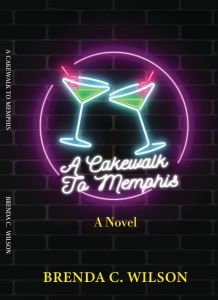
Synopsis:
In the sweltering summer of 1958, the Jim Crow South is a landscape defined by danger, secrecy, and the need to survive.
A Cakewalk to Memphis, the debut novel by Charlotte-based author Brenda Wilson, follows Big Sallie Morning, a determined Black cleaning woman from Memphis who becomes caught up in a desperate search for her pregnant niece’s missing husband. What starts as a personal mission quickly turns into a dangerous journey across a segregated South, where each bus stop presents new risks and every encounter holds hidden significance.
Big Sallie is a force of nature. Intelligent, observant, and shaped by a past she has never fully escaped, she navigates a world of smoky nightclubs, backroom gambling halls, bootlegging routes, and counterfeit schemes operating just beneath everyday life. As she seeks answers, she is also forced to confront buried parts of her own history, including the reputation that follows her from town to town.
Brenda Wilson vividly details the era with rich Southern textures. The novel moves through dry county beer joints with deceptively cheerful names, crowded juke joints where blues music carries both joy and sorrow, and a society defined by strict racial boundaries and constant danger. Each setting reveals another layer of a world where survival depends on quick thinking, tough choices, and knowing when to speak up or remain silent.
Inspired by family stories, including an aunt who was jailed in the 1940s and a cousin who became a blues singer, Wilson weaves personal history into a broader story of resilience and reckoning. Cakewalk to Memphis is a compelling historical novel about one woman’s journey through a fractured time and the strong pull of truth, memory, and responsibility.
Favorite Lines:
“Folks talked. There wasn’t much else in small towns except work, church, and gossip.”
“A woman has the right to some secrets.”
“She knew women who were willing to do anything to keep a man. But it was loneliness and the absence of love. The lucky ones learned that it was sorrow masquerading as love before it was too late.”
“I chose who I wanted to be.”
My Opinion:
I received a copy of this book from the author in exchange for my honest opinion.
A Cakewalk to Memphis hooked me pretty quickly because Big Sallie Morning is such a great character to follow. She’s stubborn, funny, suspicious of basically everyone, deeply religious but not exactly saintly, and carrying around enough regret to fill the battered bag she takes with her across Alabama.
The story is set in 1958 and follows Sallie as she leaves Memphis to track down Tony Earley, the missing husband of her pregnant niece, Rebecca. Sallie already doesn’t trust Tony, and she has a very personal reason for being terrified that Rebecca is about to repeat the mistakes she made when she was young. Twenty years earlier, Sallie went looking for her own husband after he disappeared and that decision ended with her serving ten years in prison. So when Rebecca becomes desperate to find Tony, Sallie decides she’s going to get to him first.
I loved that this isn’t really a straightforward “find the missing husband” story. Sallie’s search takes her into juke joints, boarding houses, gambling, whiskey running, blues clubs and some genuinely dangerous situations. Pretty early on, she realizes Tony hasn’t simply wandered off. He’s tangled up with people who have money, secrets, and very little interest in a middle-aged woman from Memphis asking questions.
But the mystery was almost secondary for me because Sallie herself is so interesting. She is constantly judging everyone else’s bad choices while very clearly trying to outrun her own. She’s found religion, stopped drinking, traded her old clothes for church dresses, and would very much like to believe the woman she used to be no longer exists. Except that woman keeps showing up. Sometimes literally, when Sallie finds herself back in places and around people that remind her exactly who she once was. Her friendship with Annabelle especially brings that out because Annabelle knew her before she was “saved” and isn’t particularly interested in letting Sallie rewrite history.
There’s also a really interesting generational piece to the story. Sallie thinks she’s protecting Rebecca, but a lot of what she’s doing is actually about trying to prevent her niece from becoming her. That creates this tension between wanting to save someone you love and realizing that you can’t make their choices for them. Sallie’s past marriage, her prison sentence, her relationship with her family, and even the things she has never told Rebecca keep circling back into the present.
The setting is another huge strength. This book feels very rooted in Memphis and rural Alabama in the late 1950s. You get buses and railroad towns, dusty roads, church fans, rooming houses, jukeboxes, blues singers, cheap beer, cigarette smoke, cotton fields and neon spilling out of juke joints. There’s music running through the whole thing too, with blues and jazz becoming part of the atmosphere rather than just historical name dropping. At the same time, the book never lets you forget how dangerous this particular journey is for a Black woman traveling alone in the Jim Crow South. Sallie’s awareness of where she can go, who she can trust, and when she needs to keep her head down is always sitting underneath the story.
I also appreciated that Sallie isn’t written to be endlessly admirable. She lies. She steals. She meddles. She carries knives around and has a slightly alarming willingness to use them. She can be judgmental and hypocritical, and she has a habit of convincing herself she’s doing things entirely for somebody else’s benefit when guilt is obviously pushing her just as hard. But that messiness is exactly why she worked for me. She feels like someone who has lived a whole life before page one.
The book does get a little busy once more characters and old relationships start coming into the story. There were moments where I had to remind myself who was connected to whom, and some of the plot developments get pretty dramatic. But I was invested enough in Sallie that I didn’t mind much. The larger question of whether she can actually protect Rebecca without first dealing with her own past kept the story grounded for me.
Summary:
Overall, A Cakewalk to Memphis feels like historical fiction crossed with a Southern mystery, with a little noir and a lot of family drama mixed in. It’s funny in places, genuinely tense in others, and much more interested in complicated women than perfect ones. Sallie’s journey starts as an attempt to find one missing man, but underneath that is a story about guilt, faith, motherhood, secrets, and how difficult it is to keep the people you love from making mistakes of their own. Readers who enjoy Southern historical fiction, strong older female protagonists, family secrets, historical mysteries, blues and Memphis settings, and books about complicated women trying to make peace with who they used to be may enjoy this one. Happy reading!
Check out A Cakewalk to Memphis here!