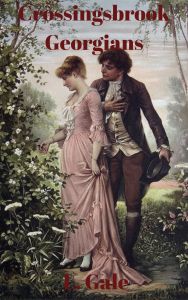
Synopsis:
In Crossingsbrook Georgians: the crossingsbrook series prequel, the back-story is told to the series, explaining how the Reverend and Clara James met, how Dr. Walton and Lady Greenfield met, the impacts of war and loss on Victor’s youth and young adulthood, the childhood friendship of Beatrice and Clara, and Beatrice’s experiences raising children that were not hers by birth. Also featured is a romantic episode between a freed slave and a free-born individual. Readers discover some of the better medical treatments available at the turn of the 19th Century, and the psychological impact that astronomical events may have had on ordinary individuals, if only by the power of suggestion. This novella fills in seventeen years, or nearly a generation, of the early lives of some of the key Crossingsbrook villagers, and introduces others who will have larger roles to play later in the series. All is told against a backdrop of the impacts of technology, legislation and cultural developments in Britain of the time.
Favorite Lines:
“After all, we’re entering the modern era now, and many people consider affection between a couple to be more important than the marriage of bank accounts and bloodlines.”
“When Victor left to return to school, Constance temporarily ruined the dog in his absence by dressing him up often in doll clothes, such that when his master returned for Eastertide and summertime of 1804, a good many hunts were required to recover the canine’s sense of masculinity.”
“Though the comet apparently did not end the world, it might have been said to have coincided with the ending of the old earth…”
My Opinion:
I received a copy of this book from the author in exchange for my honest opinion.
Crossingsbrook Georgians is one of those historical novels that is less interested in sweeping drama than in making you feel like you’ve been dropped into the everyday life of a small community. And honestly, I think that’s where it works best.
The story begins in 1798 with Lady Clara Godfrey, the daughter of a bishop who has been promised since childhood to another young bishop, Bernard Bartholomew. Unfortunately for everyone involved, Bernard is exactly the sort of man you’d hope Clara doesn’t end up marrying. He’s irritable, self-important, and generally unpleasant to have around. Clara’s father’s household staff seem to agree, and their efforts to make his visit as uncomfortable as possible give the opening chapters a surprisingly funny, slightly mischievous energy.
But the heart of the story quickly becomes Clara and Theodore “Theo” James, her father’s chaplain and secretary. Their relationship has a very gentle quality to it. These are two people who already know each other well and genuinely like one another, so their connection feels rooted in friendship and familiarity rather than instant attraction. Theo is also much more interested in actually serving people than in climbing the church hierarchy, which eventually brings Crossingsbrook itself into the center of the story.
And Crossingsbrook really does become a character of its own.
Once the story settles into the village, the book expands into something closer to a family and community chronicle. We see parish life, births and marriages, funerals, holidays, dinners, church gatherings, household routines and the small dramas that come from living in a place where everyone knows everyone else. There are even things like a village magic lantern show and excitement over early steam transportation, which I enjoyed because they make the historical setting feel lived in rather than simply decorative.
The Greenfield family becomes especially important as the book progresses. After tragedy strikes Greenfield Hall, Lady Beatrice steps into a family situation she wasn’t exactly prepared for, including caring for young Victor and his baby sister. Victor’s grief is handled with more patience than I expected. He’s angry and somewhat wild at first, and the adults around him don’t immediately try to force him into behaving as though nothing happened. His friendship with the newly arrived Dr. Rex Walton is particularly sweet and becomes an important source of stability for him.
Beatrice was probably one of the more entertaining characters for me. She’s proper and particular, but not nearly as stuffy as she initially seems. Her interactions with Rex add another little thread of romantic tension, while her attempts to figure out how to suddenly become responsible for two children give her some much needed vulnerability.
There’s also a longstanding feud between the Greenfields and Fairhavens running quietly through the background. I liked that the book doesn’t immediately turn this into some huge melodramatic conflict. Instead, you start noticing little cracks in the wall between the families, particularly as the younger generation grows up. By the later portion of the book, you can pretty clearly see how these relationships and old grudges are laying groundwork for whatever comes next in the Crossingsbrook series.
One thing readers should know going in is that this isn’t really structured like a conventional historical romance with one central couple and one major conflict driving everything toward a climax. It’s much more episodic. Years pass, children grow up, people leave for school, historical events creep into village life, families change, and characters who seemed secondary earlier become increasingly important. In that sense, it really does feel like a prequel. Its job is to introduce the families, relationships, history and little bits of baggage that will matter later.
There’s also quite a lot of historical detail woven throughout. Religion plays a particularly large role because Theo is a clergyman and Clara is a bishop’s daughter, but the book also touches on education, class, household servants, medicine, technology, politics, village traditions and changing social attitudes. Occasionally the historical information becomes more prominent than the plot itself, so readers who want a fast, tightly plotted story may find the pacing leisurely. But if you’re someone who likes the everyday details of another era, there’s a lot here to enjoy.
What I liked most was probably the sense of continuity. You aren’t just watching one romance happen. You’re watching a community take shape across years. People marry, have children, lose people they love, grow older and gradually hand more of the story over to the next generation. By the end, characters we first encountered as children are moving into adulthood with histories and relationships that already feel established. It makes Crossingsbrook Georgians feel less like a standalone adventure and more like opening an old family album and finally learning the stories behind all the people in it.
Summary: Overall, Crossingsbrook Georgians is a gentle, character driven Georgian historical novel that follows several interconnected families in the village of Crossingsbrook beginning in the late 1790s. There’s romance, family life, grief, village gossip, religion, old family rivalries and a surprising amount of everyday historical detail. Readers who enjoy gentle, character driven historical fiction where the pleasure comes from spending time in a community and watching relationships develop over years, rather than racing through a single dramatic plot may enjoy this book. Happy reading!
Check out Crossingsbrook Georgians here!