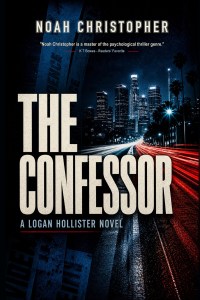
Synopsis:
A killer is making Los Angeles confess.
The Confessor is never wrong. He has built his whole life around being sure of it.
He chooses people who got away with it — never charged, never even suspected. The charity director who gutted his own foundation. The smiling influencer who built an empire on a lie.
He sits them down alone with a pen and a yellow legal pad, and waits as long as it takes for the truth in their own hand.
Then he balances the account.
The confessions are real. But on paper, nothing connects the victims — separate lives, separate crimes, no thread that should tie one death to the next.
Detective Logan Hollister has every reason to stay out of it. The money came a long time ago; the house is an hour down the coast, the kind of quiet other men spend their whole lives chasing. Logan can only tolerate it in small batches before he wants back in. He keeps the badge, works the cases that still mean something, and this is the one he can’t walk away from.
On the surface, he and the man he’s hunting are opposites. One has everything a life can hold. The other spent years making himself into no one at all.
But the bodies keep coming, and the difference between them keeps thinning — until Logan can’t always tell whether he’s hunting the man or recognizing him.
Favorite Lines:
“Everybody with a secret and a blazer had done a TED talk.”
“The truth had to come on its own, the way water finds its level.”
“The days of chasing a ghost were gone. Now he was hunting a man, and the hunt was drawing close.”
“Some part of him, far down, mistook a train leaving its rails for the feeling of being free.”
My Opinion:
I received a copy of this book from the author in exchange for my honest opinion.
The Confessor starts with a killer who doesn’t simply want his victims dead. He wants them to admit what they’ve done first. His targets are people hiding behind carefully constructed public images, and he does an unsettling amount of homework before confronting them with the truth. The opening, involving a respected charity figure and some very questionable finances, immediately establishes what makes this killer interesting: there’s a twisted logic behind what he’s doing. He doesn’t see himself as indiscriminately violent. In his mind, he’s exposing people who deserve to be exposed. That makes the moral line running through the book considerably messier than your standard serial killer thriller.
On the other side of the story is LAPD detective Logan Hollister, who is probably the biggest reason I enjoyed this as much as I did. Logan has money, a Tesla, a house in Laguna Beach, and enough independence within the department to operate a little differently than everyone else, but he also seems almost incapable of actually enjoying the quiet life he has built for himself. Los Angeles and the work keep pulling him back. His partnership with Curt Alton gives the book some much needed humor and personality, especially because Curt is one of the few people who seems completely unimpressed by Logan being Logan. Their dialogue feels easy and lived in, and I liked their relationship almost as much as the investigation itself.
There is also more going on with Logan than the other characters realize. He secretly owns WLTLH, an investigative news site that has grown far beyond the little local operation he originally created. That becomes much more than an interesting character detail once The Confessor and WLTLH begin brushing up against each other. Logan suddenly has access to information as a journalist that he cannot exactly walk into the police department and explain without exposing a huge part of his life. I thought this was one of the more original pieces of the book because it gives him two different ways of hunting for the truth, while also creating a pretty significant problem when those two identities collide.
The story alternates between Logan’s investigation and The Confessor himself, so this isn’t really a mystery where you spend the entire book trying to guess what the killer is doing. A lot of the tension comes from watching both sides work and wondering when their paths are finally going to meet. The Confessor studies people with almost obsessive patience, while Logan is similarly good at noticing the tiny details other people overlook. That parallel makes them feel strangely well matched. The book also has a very strong sense of Los Angeles, moving between expensive Westside shops, diners, churches, freeways, ordinary neighborhoods and Logan’s quieter life down in Laguna. It gives the story a contemporary, very lived-in feeling rather than using LA as generic crime-thriller scenery.
At a little over 400 pages, The Confessor is substantial, but it reads quickly because the chapters tend to keep pushing you into the next piece of the investigation. There are stretches where the book gets very detailed about how Logan or The Confessor thinks through something, which may be more procedural than some readers want, but I actually think that detail is part of the appeal here. You get to understand how both men think rather than simply watching clues appear when the plot needs them. More than anything, this feels like the beginning of a crime series rather than a standalone thriller with a detective who happens to solve one case. Logan, Curt, WLTLH and the larger world around them all feel built to continue beyond this story, and I would be interested in seeing where the series takes them next.
Summary:
Overall, The Confessor is a smart, fast-moving crime thriller about an LAPD detective hunting a killer who forces seemingly respectable people to confess the ugly truths they have been hiding. The alternating perspectives make the cat-and-mouse element especially fun, while Logan’s secret life as the owner of an investigative news site adds a genuinely interesting complication. Readers who like police procedurals, serial killer thrillers, morally complicated villains, clever detective work, strong partner banter and contemporary Los Angeles settings may enjoy this book. Happy reading!