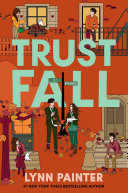
Halfway through, there is a costume ball in a medieval cloister at the northern tip of Manhattan. The theme is Edith Wharton. A girl from a small town has come dressed in red, which in Wharton’s world is how a society marks a woman as finished; the boy who is in love with her has come dressed entirely in white, because somebody told him to be a blank canvas and he took the instruction personally. Then a man in an ordinary suit works his way through the dancers with an envelope. Trust Fall by Lynn Painter is a funny teenage romance for four hundred pages and a novel about class for about ninety seconds, and those ninety seconds happen at the Cloisters.
The Season, and Who Pays for It
The setup is an estate dispute. An old man called Remington Rutledge leaves Riverside Manor, a house on the Upper West Side, to a family of four from rural Nebraska who knew him only as an eccentric summer visitor. The bequest comes with strings: residence for half a year, and a place at Gardenwood Academy for the teenage twins.
The great-nephew who assumed the house would be his is a Gardenwood senior, and his father goes to court to argue that the old man had lost his judgement. So the two leads of Trust Fall by Lynn Painter meet as opposing parties in a lawsuit, inside an institution that is already keeping score.
What Painter understands, and what makes the novel worth a group’s evening, is that the lawsuit is the polite version. The real penalty is administered at school, for free, by sixteen-year-olds.
Trust Fall and the Vocabulary of Gardenwood
The school has a language for this, and the language is the novel’s sharpest piece of observation.
Skins and Toms, the two castes: the newly enormous money, and the families who have been there long enough not to discuss it.
New Money, deployed as an insult rather than a description, which is the whole trick.
The Corn Queen, the nickname assigned to a girl whose crime is a state.
The blank canvas, which is what a boy is called when his function is to be looked at and inherited from.
None of these is invented for the book; all of them are doing what Wharton’s drawing rooms did, which is to convert money into manners so the cruelty can be deniable.
What the Novel Does Beautifully
The dual narration is the technical achievement. Painter gives the boy a spoken voice and an interior one and keeps them in open contradiction for three hundred pages: he says the bored, dismissive thing out loud and the italics underneath record the panic. It is the oldest tool in two-voice romance and it is handled with real discipline here, because he lies out loud roughly as often as a frightened eighteen-year-old actually would, rather than only when the plot requires a misunderstanding.
The Wharton frame is more than fancy dress. The ball could have been a dressing-up chapter and instead the third act runs on Wharton’s own subject: a closed society punishing somebody for wanting the wrong thing in public. The humiliation that breaks the couple apart is staged where everyone can see it, which is the point.
And the twin brother is a person. He has friendships that have nothing to do with his sister, a Gardenwood problem of his own, and the two funniest lines in the book. He is also the one who forces the confession that turns the ending, which means the climax of Trust Fall by Lynn Painter hinges on a sibling rather than on a grand gesture. Groups who are tired of the best-friend-shaped plot device will notice.
Where Trust Fall by Lynn Painter Lets It Slide
The social cruelty is introduced with teeth and then simply stops. No teacher is ever shown noticing it. No student is ever asked to account for it. By the final chapters Gardenwood has become scenery, and the girl who spent a year being tormented there is never made to work out how she feels about the students who did the tormenting. For a novel this interested in class, declining to bill anyone is a strange ending.
The father in Trust Fall by Lynn Painter folds too fast, too. A man prepared to litigate his dead uncle’s competence changes his mind inside one conversation, and nothing the reader has been shown of him makes that plausible. The scene is well written; the capitulation is unearned.
Then the reconciliation, which is assembled out of other people’s poetry. Two borrowed lines, one from a contemporary collection the characters both love and one from Whitman, carry almost the entire emotional load of the final scene. It plays, and it also means the most important thing these two ever say to each other was written by somebody else.
And the apparatus at the back is longer than some of the chapters: a thirty-two track playlist with a streaming link, plus acknowledgements of considerable warmth. Harmless, and a fair indication of what the book takes itself to be.
For the Group
Open Trust Fall by Lynn Painter on the obvious question and let it run: what is Gardenwood actually for? Not the fictional school, the real category. Everyone at the table went to school with a version of the Skins, or was one.
Then the harder question. The novel is unmistakably on the Nebraska family’s side, and it still asks them to earn their place by passing tests and attending parties. Ask the room whether the book is critical of that bargain or quietly in favour of it.
Then the humiliation scene, which is the hinge of Trust Fall by Lynn Painter. The girl says the single worst available thing to the boy, in public, in the exact vocabulary his tormentors use, and the novel treats the episode as something he has to apologise for. Nobody at the table will think that is balanced, and the disagreement about why is the good part.
Finally, the ending, which is more honest than the genre usually allows: a negotiated settlement with a parent who has moved perhaps fifteen per cent, accepted rather than defeated. Ask whether that is maturity or capitulation. Readers over thirty tend to answer differently from readers under twenty.
Content notes, briefly. There is a death before the book opens, and two narrators grieving it throughout. A medical emergency involving a food allergy. A year of class-based bullying, with one set-piece humiliation. One punch; one broken nose. Alcohol at a party. A lawsuit against a grieving family. A father treating a child’s future as something to trade. Romance that stays firmly within young-adult limits. The dedication names a young woman who did not survive 2026. She was real, and she is not part of the story.
More for the group: Maid for Each Other by Lynn Painter is the companion pick if the author’s voice is the draw. The Academy by Elin Hilderbrand and Shelby Cunningham suits a group that wants more of the private-school machinery. Switzy by Emma Cline is the adult counterweight on money and proximity to it. And The Lovers, the Liars, and Me by DeAndra Davis works if a strong teenage narrator is what the room responds to.
What It Leaves Behind
The dead man. Every one of the fifty-eight sections, two prologues and an epilogue included, opens with a single line attributed to Remington, and he is never given a chapter of his own. His lines keep landing on top of events that took place after his death. He is the only figure here with no interests left to protect, and by the last page a reader knows him better than most of the living.
That device is why Trust Fall by Lynn Painter survives being sixty pages too long and dropping its best thread. It is a romance with a genuine argument underneath it about who gets to belong somewhere, and it hands a group four hours of disagreement about whether the argument is won. Bring it to a room that likes to take sides.