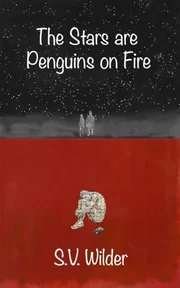
Wilder’s novel unfolds entirely within the uninterrupted narration of Warner Truman, an 18-year-old high school graduate whose tendency to self-aggrandize is immediately apparent: “I’m going to be president one day. No doubt about it.” Warner also announces that he is a hero, promising to eventually explain the tumultuous events that he feels have earned him that title. The world outside Warner’s head is chock-full of people he resents. He despises his own father while idolizing his grandfather Jed, a former police officer whose questionable behavior Warner invariably interprets as evidence of strength and intelligence. Warner’s version of an earlier family tragedy provides the first reason to question his own perspective: His younger brother, Randy, was paralyzed after jumping from a window. But while Warner insists he was in the bathroom at the time, he acknowledges contradictory accounts and a lingering “seed of doubt” about his role in the accident. At school, Warner navigates a world dominated by bullies like Deke Smith and the vile Coach Kennedy. His relationship with his girlfriend, Carly, deteriorates as she grows closer to a boy Warner hates named Carter Bedford. He also befriends Joey, a lonely student who’s relentlessly mocked for his weight; as part of Warner’s insistence on his own benevolence, he appoints himself the isolated boy’s new “mentor.” Uncertainties start to multiply as Warner observes Coach Kennedy’s abusive behavior toward Joey and female students—especially when he learns that Joey keeps an AK-47 hidden in his basement. Despite Warner’s insistence on being a good person—“If somebody needs help I’m your man”—his attempts to quietly manage everyone around him get more and more pronounced. As bullying, abuse, romantic jealousy, and simmering violence increasingly rise to the foreground, Warner’s promised explanation of his supposed heroism begins to look considerably more complicated.
Wilder’s impressive commitment to Warner’s consciousness creates a surprisingly multifaceted novel despite confining readers to a single perspective. Scenes remain dynamic as Warner’s mind constantly darts between narration, memories, jokes, and self-justifications. His voice can also be very funny. (One extended and memorably quirky tangent confidently argues that Gandhi was actually Jack the Ripper.) Wilder channels an extensive literary knowledge through Warner as well; the ideas of Orwell, Steinbeck, and other writers all get filtered through Warner’s peculiar interpretative mind. Warner’s psychology is skillfully rendered, particularly when the narrator seems determined to convince readers of his heroism by insisting on the opposite in his characteristically vulgar fashion: “I’m not a hero despite what happened later. I’d be a pawn under a dictatorship. Likely sell my buddies up the river to keep my balls out of a vice.” But Wilder’s fascinating experiment can also be exhausting. The novel’s nearly uninterrupted blocks of text, with little conventional punctuation or paragraphing, is abrasive and frequently unpleasant, especially because Warner’s caustic perspective focuses increasingly on potentially upsetting subject matter. Wilder’s acerbic humor, often channeled through Warner’s ceaseless cynicism, feels sharp and precise, but it leaves little room for the horrific events the author describes to fully coalesce. While admirable for its style and technique, Wilder’s deep dive into this strange antihero’s psyche may leave some readers eager to escape his company.