Synopsis:
Mark Robson is trapped in flux.
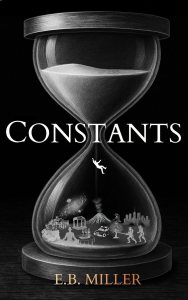
Every 18 minutes and 32 seconds he wakes up in a new reality, then dies.
The only clues to help him stop this crazed cycle and return home to his pregnant wife are the people, things, and events that reappear across worlds,
…or what he calls his constants.
Told in real time, with every chapter unfolding in a different world, Constants is a tightly-plotted exploration of reality, identity, and humanity’s search for meaning across the furthest reaches of our collective imagination.
Favorite Lines:
“That truth has to live somewhere, so for now it resides in his head.”
“Death was the exclamation mark at the close of that final inescapable argument of life’s utter meaninglessness.”
“You can’t leave me. You’re a constant.”
“Meaning takes shape from afar, so appreciate what you can.”
My Opinion:
I received a copy of this book from the author in exchange for my honest opinion.
Constants is one of those books that starts with a premise that sounds fairly easy to explain and then gets much, much stranger the longer you read (in a good way). Mark Robson is trapped in what he calls “flux,” where every eighteen minutes and thirty-two seconds he finds himself somewhere new, usually shortly before dying in some increasingly bizarre way. One moment he might be sitting in a psychiatrist’s office, the next he is somewhere completely removed from the world he knows. The only things he can really hold onto are the patterns that keep repeating, particularly his wife Lya, the exact eighteen-minute-and-thirty-two-second countdown, and eventually his troubled twin sister Alex. At first, I was mostly interested in figuring out the mechanics of what was happening to Mark, but the book gradually makes it clear that the bigger question isn’t really where he is. It’s why any of it is happening at all.
A lot of what makes the story work is how ridiculous and serious it manages to be at the same time. Some of Mark’s existences are genuinely funny or completely absurd, while others are violent, frightening, or surprisingly sad. The constant countdown gives even the strangest worlds a sense of urgency because Mark knows that no matter what he discovers, he only has a few minutes before everything disappears again. I also really liked the recurring therapy sessions with the Psychiatrist. Those scenes give the story somewhere to breathe and allow Mark to actually examine the theories he keeps developing about flux. Is he hallucinating? Dead? Jumping between dimensions? Is someone controlling him? The running percentages Mark and the Psychiatrist assign to the different possibilities were a clever way to show how their thinking evolves as the evidence changes.
What surprised me most was how much emotional weight the story eventually gives Mark’s relationships. Lya initially seems like his one safe place, but even that becomes complicated because the versions of her he encounters don’t necessarily share the same history he remembers. Meanwhile, his search for Alex becomes increasingly important as we learn more about their childhood, their mother’s death, Alex’s addiction, and Mark’s guilt over not being able to save the people he loves. Underneath all the strange worlds and increasingly elaborate deaths, Mark is someone who was struggling with emptiness long before flux began. He keeps believing that if he can just solve the mystery, find the right constant, or get home to Lya, he will finally feel whole. The book gradually starts questioning whether returning to his old life would actually fix anything.
The final portion is where Constants takes its biggest swing, and I think it will also be the part readers have the strongest opinions about. Without completely spoiling it, the answer to Mark’s situation changes the context of basically everything that came before it. The novel becomes openly metafictional and turns Mark’s search for a creator back onto the act of storytelling itself. I thought that was ambitious, especially because the book doesn’t use the reveal simply as a clever twist. Mark is furious about what has been done to him and refuses to conveniently turn his suffering into the profound lesson his creator wants from him. That confrontation ended up being one of the most interesting parts of the novel for me because it asks whether suffering really needs to produce meaning at all, or whether that’s just another story we tell ourselves because we’re uncomfortable with the possibility that there may never be a satisfying answer.
I also appreciated that the ending ultimately lands somewhere quieter than I expected. After spending so much of the book desperately searching for certainty, Mark doesn’t necessarily find it. Instead, he reaches something closer to accepting uncertainty itself. The idea that darkness and the unknown don’t automatically equal emptiness felt like a fitting conclusion for a character who has spent so much of his life terrified that nothing matters. Constants is definitely weird, philosophical, occasionally chaotic, and sometimes deliberately frustrating, but I think that’s also what makes it memorable. It takes a very strange science fiction premise and uses it to ask surprisingly human questions about why we’re here, whether anyone is watching, and whether a fleeting moment can still matter even when we know it has to end.
Summary:
Overall, Constants is a strange, ambitious blend of science fiction, dark comedy, existential fiction, and metafiction that follows a man trapped in a cycle of new realities that reset every eighteen minutes and thirty-two seconds. What initially feels like a mystery about multiverses and repeated deaths gradually becomes much more interested in depression, mortality, faith, memory, free will, and our need to believe there is some larger explanation for why we suffer.
I think this will work best for readers who enjoy high-concept speculative fiction that isn’t afraid to get philosophical, especially those who like stories about alternate realities, unreliable perceptions of reality, existential questions, and books that eventually become aware of themselves as stories. Readers who need very concrete worldbuilding rules or a straightforward explanation for every mystery may find parts of it frustrating, but readers willing to follow the book into increasingly strange territory will find a lot to think about after it’s over. Happy reading!