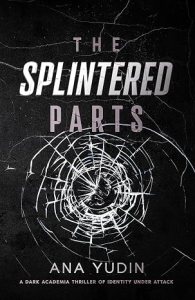
Synopsis:
Someone—or something—is trying to bury itself inside Soraya’s skin.
It started her sophomore year of college, after she slipped in the shower and hit her head. Since then, nothing has felt real. The lights flicker all at once. She hears tapping at her window, and someone outside keeps calling her name.
Desperate to understand what’s happening to her, Soraya enters a neuroscience doctoral program in the Southwestern desert. But the deeper she dives into her studies, the more the line blurs between reality and distortion.
As a rare solar eclipse approaches, Soraya races to uncover the mystery. Eclipses have a way of exposing what’s been lurking in the dark, and if Soraya gets it wrong, she may lose far more than her sanity.
Favorite Lines:
“Just because something felt real didn’t mean it was.”
“Soraya hated the ‘tell me about yourself’ question. She was supposed to toe the fine line between personable and professional. If she answered frankly with a narration of her autobiography, then she’d seem too personal and self-involved. But if she answered too professionally, she’d be deemed impersonal—and likability was important currency in the world of academics.”
“Not everyone is so sure of their passion in life like you seem to be. Some of us look and look for it, but it never comes.”
My Opinion:
I received a copy of this book from the author in exchange for my honest opinion.
Psychological thrillers can be difficult to pull off because they ask readers to question everything they’re seeing without making the story feel unfair. The Splintered Parts does a nice job walking that line. From the opening chapters, there’s an unsettling feeling that something isn’t quite right, and while the book introduces plenty of possible explanations along the way, it never rushes to give the reader answers. Instead, it slowly builds an atmosphere of uncertainty where every strange event leaves you wondering whether Soraya is dealing with a mental health crisis, something neurological, something supernatural, or perhaps a combination of all three. I found myself constantly second-guessing what I thought was happening, which is exactly what I want from this type of story.
Soraya is an interesting main character because so much of her internal conflict exists outside of the mystery itself. She’s a neuroscience Ph.D. student researching consciousness and near-death experiences, but she’s also someone who can’t seem to shake the feeling that she’s living a life she didn’t entirely choose. Throughout the story, the tension between pursuing a practical career and pursuing something that genuinely fulfills her becomes just as compelling as the strange events surrounding her. I also appreciated that the scientific discussions never felt like they were there simply to sound impressive. They fit naturally with Soraya’s academic interests and gave the mystery a unique angle that separates this from many other psychological thrillers.
The relationships were another highlight for me. Soraya’s friendships, her complicated relationship with her family, and especially her interactions with her younger sister all add another layer to the story. There are moments where the family dynamics feel painfully realistic, particularly when expectations, comparisons, and career choices come into play. Even when I didn’t always agree with Soraya’s perspective, I understood why she reacted the way she did, which made her feel like a believable and flawed protagonist rather than someone who was simply easy to root for.
The atmosphere is probably what stayed with me the most after I finished reading. The Arizona desert, the hiking trails, the research lab, and Soraya’s apartment all gradually become places that feel just a little off, creating an almost dreamlike sense of unease. Yudin also does a good job weaving together psychology, folklore, neuroscience, and speculative ideas without losing sight of the emotional story underneath. By the end, I found myself thinking less about the mystery itself and more about the questions the novel raises regarding identity, purpose, and the different versions of ourselves that might exist because of the choices we’ve made throughout our lives.
Summary:
Overall, The Splintered Parts is an ambitious psychological thriller that blends science, suspense, paranormal elements, and introspection into something that feels different from many books in the genre. Readers who enjoy stories that slowly unravel rather than relying on constant action will likely appreciate the pacing, and anyone interested in unreliable perceptions, consciousness, speculative science, or character-driven mysteries should find plenty to enjoy here. It’s a thoughtful story that asks readers to question not only what’s happening to the main character, but also how much our own identities are shaped by the paths we choose to follow. Happy reading!
Check out The Splintered Parts here!