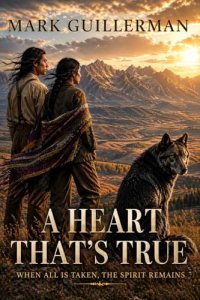
Synopsis:
When all is taken, what remains?
In 1912, twelve-year-old Joseph Cross and his cousin Elizabeth White Cloud are torn from the foothills of Montana and sent across the country to the Carlisle Indian School, where children are stripped of their language, their traditions, and even their names.
Separated from home and forced into a world that sees them as something to be remade, Joseph and White Cloud must learn to survive in ways they never imagined. They face loneliness, danger, and a system determined to erase who they are. Yet through friendship, courage, and the teachings of their people, they begin to discover a strength no one can take from them.
Where courage walks, the spirit follows.
Along the way, their journey becomes intertwined with the legend of Big Black, a powerful wolf whose story mirrors their own struggle to belong in a world that fears what it does not understand.
A Heart That’s True is a moving and unforgettable story of resilience, identity, and the unbreakable bond between family, culture, and spirit. Inspired by real historical events, this novel shines a light on a chapter of history that must never be forgotten—and celebrates the courage to remain true to who you are.
Favorite Lines:
“The human spirit will never die in a heart that’s true.”
“The smell of the fresh morning air was strong medicine for Joseph.”
“Her grandfather had taught her many things in her young life, and one thing stood out: always remember and learn from her past.”
My Opinion:
I received a copy of this book from the author in exchange for my honest opinion.
A Heart That’s True is historical fiction that takes on a part of American history that is incredibly difficult to read about, but important to remember. The story follows twelve-year-old Joseph Cross, a Lakota boy taken from his home in Montana and sent across the country to the Carlisle Indian Industrial School. Before he leaves, his grandfather gives him a piece of advice that basically becomes the heart of the entire book: no matter what happens to him, he has to hold onto who he is.
I think what worked best for me was that the book doesn’t only focus on the cruelty of Carlisle itself. A lot of the story is really about Joseph’s fear of losing his identity. There’s a moment before he even reaches the school where he meets an older Native student who has already adopted the clothing, speech, and mannerisms expected of him, and Joseph is genuinely terrified by what he sees. He’s been warned that people will try to “wash” his spirit away, and suddenly he understands what that might actually look like. That fear follows him throughout the book and makes even some of the quieter parts of his time at Carlisle feel unsettling.
Joseph’s relationship with his cousin White Cloud was another part I really liked. They’re separated after arriving at Carlisle, but their connection to each other and to their grandfather gives the story an emotional anchor. White Cloud is also a compelling character on her own. She’s older, more guarded, and much more aware of what is happening to them, while Joseph still has a little bit of childhood innocence left.
And then there’s Big Black, who honestly ended up being one of my favorite parts of the book. He’s a huge black wolf/Newfoundland mix Joseph meets during the journey east, and their immediate connection initially seems like a sweet little break in an otherwise bleak situation. But Big Black becomes much more important than that. Joseph connects him to Lakousa, the Wolf King from one of his grandfather’s stories, and the wolf becomes tied to this larger idea of home, freedom, and the part of Joseph that Carlisle can’t take away. I really liked how that storyline brought a slightly mythical feeling into what is otherwise pretty grounded historical fiction.
There are also quite a few real historical figures and events worked into the story. Jim Thorpe has a particularly meaningful role rather than just popping up for the sake of having a recognizable name. His quiet friendship with Joseph becomes another source of encouragement for him, especially when Joseph is able to tell the stories his grandfather taught him instead of being ashamed of them. I thought those scenes were some of the strongest because they show resistance in a much quieter way. Joseph isn’t necessarily making some huge rebellious stand. Sometimes simply remembering and telling his people’s stories is the rebellion.
I did think the writing could be a little heavy on historical explanation at times. There are sections where the story pauses to give quite a bit of background on people, places, and events.. At the same time, I understand why so much context was included, especially because Carlisle and the broader history surrounding Indian boarding schools may be unfamiliar to some readers.
Summary:
Overall, A Heart That’s True is a moving story about identity, family, survival, and refusing to let someone else decide who you are. There are some genuinely painful parts, but there is also a surprising amount of warmth in Joseph’s relationships with White Cloud, Big Black, and the people who show him kindness along the way. It isn’t necessarily a light historical fiction read, but it has a lot of heart. I’d recommend this to readers who enjoy American historical fiction, coming-of-age stories, books about Indigenous history and boarding schools, animal-human bonds, and stories centered around resilience, family, and finding your way home. Happy reading!
Check out A Heart That’s True here!