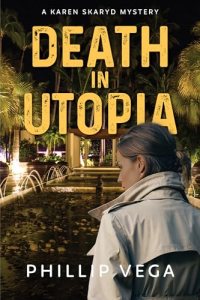
Synopsis:
An idyllic paradise. A deadly secret. A detective who can’t escape the past.
When Detective Karen Skaryd and her husband arrive at a luxurious Caribbean resort to celebrate their twenty-fifth wedding anniversary, they expect sun, relaxation, and romance. But when a prominent guest drops dead in the middle of lunch—with a cryptic biblical message left behind—Karen is thrust into a web of lies, power, and murder.
As she navigates law enforcement politics, elusive suspects, and a retired senator with secrets of his own, Karen soon realizes that this case may be tied to something much darker than she ever imagined. With danger lurking in paradise, she must uncover the truth before the killer strikes again.
Because in Utopia, nothing is what it seems.
Favorite Lines:
“Honey, never forget—a keen mind will always be your best tool.”
“Panicking won’t help. We simply stick to the facts and let them chase the shadows.”
“You can’t come to the Dominican Republic and not eat your weight in food.”
My Opinion:
I received a copy of this book from the author in exchange for my honest opinion.
Death in Utopia has a setup I’m almost always going to enjoy: a detective goes on vacation, fully intending not to be a detective, and then someone dies. Karen Skaryd and her husband Brock are in Punta Cana celebrating their twenty-fifth anniversary while also attending an international rose society event, thanks to Brock’s very serious interest in growing roses. The resort is beautiful, the drinks are flowing, there are plenty of eccentric personalities around, and then one particularly unpleasant member of the rose society suddenly dies under suspicious circumstances. Karen may technically be off duty and very much outside her jurisdiction, but there is basically no chance she is going to ignore what she sees.
Karen was probably my favorite part of the book. She is observant, stubborn, experienced, and constantly slipping into what Brock calls her “detective eyes,” even when she is supposed to be relaxing. Their marriage also gives the story a nice grounding point. They have been together long enough that their conversations feel comfortable and familiar, with the kind of teasing and minor irritation that makes them seem like an actual married couple rather than two characters who exist only to move the mystery forward. Brock is also more than just the spouse waiting back at the hotel while Karen investigates. His rose obsession is what brings them into this particular group of people in the first place, and their relationship helps keep the story lighter even as the situation around them becomes increasingly dangerous.
The mystery itself gets much bigger than the first death suggests. There are biblical messages, a growing list of people who may or may not be telling the truth, suspicious resort employees and guests, international law enforcement complications, and someone who seems very interested in making sure Karen knows she is being watched. I liked that the book gives you a lot of possible directions to look without making every suspicious person feel like an obvious red herring. Karen is also at a disadvantage because she has no real authority in the Dominican Republic, which leads to some friction with Inspector Montenegro. She wants to investigate the way she normally would, while he is understandably not thrilled about an American detective inserting herself into his case.
The tropical setting is a fun contrast to the darker material. One minute Karen and Brock are surrounded by ocean views, elaborate floral displays, resort restaurants and a competitive group of rosarians, and the next Karen is looking at a crime scene or following someone through a crowded tourist area. The book also has a fairly large supporting cast, including Montenegro, Wolfram, Alvarez and a number of resort guests and staff, so there is usually another relationship or secret being introduced as the investigation progresses. At times there is a lot happening, especially once the mystery expands beyond the resort itself, but that also keeps the story moving and gives it more of an adventure-thriller feel than a quiet traditional whodunit.
What surprised me most is that Death in Utopia doesn’t really wrap itself up like a completely self-contained vacation mystery. The immediate investigation builds toward a much larger threat, and the opening scene makes more sense once you see where the story is headed. I think readers who enjoy series mysteries will probably appreciate that more than readers looking for everything to be neatly tied up by the final page. This feels very deliberately like the beginning of Karen Skaryd’s story, with her family life, police career and a particularly dangerous adversary all positioned to continue into future books. There are some darker moments along the way, but the overall reading experience still feels accessible and entertaining rather than grim. I am excited to see where Vega takes Karen’s story next!
Summary:
Overall, this is a vacation mystery that gradually turns into something much bigger. Readers who like amateur-out-of-necessity investigations, police procedurals, tropical destination mysteries, married protagonists, large suspect pools, serial-killer elements and mysteries that continue into a larger series may enjoy this one. Happy reading!
Check out Death in Utopia here!