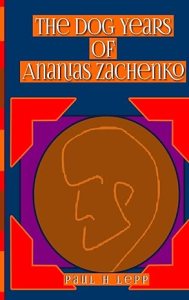
Synopsis:
What do you do when you run out of time? Ask Ananias Ezra Zachenko what he did after he was diagnosed. He set an agenda, took care of finances, delved into relationships, considered the heroic act. Didn’t go into denial, but defiance, there’s a difference.
He put it all in motion during the time he had left. A dog gets seven years to our one. Chenko rationalized the relationship by taking the best from both, our days the dog’s years and began to calculate. Anything to lengthen the short leash he is on.
During his dog years he planned for everything, but nothing turned out as expected. He concentrated on time, when he should have been looking at weight. No matter the type of year, when one runs out of time on this side, one has to figure out how to make weight on the other side.
Favorite Lines:
“He reasoned as he waited, we’re just a wristwatch on the arm of time and can only be wound so many times or wear down so many batteries. Springs unwind, batteries go dead, and we stop. A watch never shows the same face twice when glanced at to see how much time has been used or how much time is left. Always leaving one to wonder if it’s the correct time. All the time, wishing for more, other times wishing for less. Such were the thoughts of Ananias Zachenko, better known as “Chenko,” as he entered the dog years of his life.”
“There is nothing permanent about us; no one gets out alive. Earth is a planet where all is temporary.”
“Change is a soul who wears many coats; some fit, some don’t.”
“Fate is like giving a box of matches to an arsonist; one doesn’t really know what they’ll do, but one has a pretty good idea. Fate is neither kind nor unkind; it’s like water and rive, as it can relieve your thirst and keep you warm one moment, or down and burn down all that’s around you the next. Fate doesn’t care. Fate is just something out there that everyone has to deal with; it can’t be controlled, only survived.”
My Opinion:
I received a copy of this book from the author in exchange for my honest opinion.
This book opens with a man who understands, almost immediately, that his life has changed — not because of what he’s lost yet, but because of what’s been measured for him. Ananias Zachenko doesn’t rage against the diagnosis. He doesn’t dramatize it. Instead, he does something much more unsettling: he thinks. He observes. He calculates. He looks for leverage inside time itself.
The “dog years” metaphor could have been gimmicky. It isn’t. It becomes structural. Philosophical. Emotional. Time stops being linear and starts behaving like something you can bend, misinterpret, ration, or waste without noticing. The book doesn’t rush to reassure you that this is meaningful. It lets the idea sit there and bother you.
What surprised me most is how grounded the story feels even when it drifts into abstraction. This is a book full of ordinary movements — driving, eating breakfast, sitting in parking lots, handling paperwork — and yet each of those actions feels heavier than it should. Lepp captures that strange sensation where nothing looks different from the outside, but everything is already irrevocably altered.
Chenko (and the name itself matters here) is not written as a hero. He’s written as someone aware of his own limits. He knows where he’s strong, where he’s compromised, and where he’s lied to himself. The chess metaphor isn’t about winning — it’s about realizing you’re already mid-game and deciding whether to play anyway.
There’s a tenderness in the way memory is handled, especially when the narrative dips backward into childhood and scouting stories. Those sections don’t feel like nostalgia for comfort’s sake. They feel like an inventory: what shaped him, what taught him risk, what taught him responsibility, and what taught him that sometimes you step forward because someone else can’t.
By the time the book settles into its later chapters, the question isn’t “how long does he have?” It’s “what does time owe him — if anything at all?” The story doesn’t offer clean answers. It offers presence. Awareness. The recognition that control is often an illusion, but attention is not.
This is a book about illness, yes. But more than that, it’s a book about measurement. About how humans insist on quantifying what can’t be safely divided. About how love, memory, and meaning refuse to obey calendars. And about how sometimes the bravest thing you can do is stay inside the moment instead of trying to outrun it.
Summary:
Overall, The Dog Years of Ananias Zachenko is a quiet, thoughtful novel about illness, time, and the way diagnosis forces a person to renegotiate their relationship with living. Grounded, reflective, and emotionally restrained, this story explores how we measure time when the future becomes uncertain — and whether time can ever really be controlled at all. Happy reading!